Classical Ayurvedic Profile & Preparation
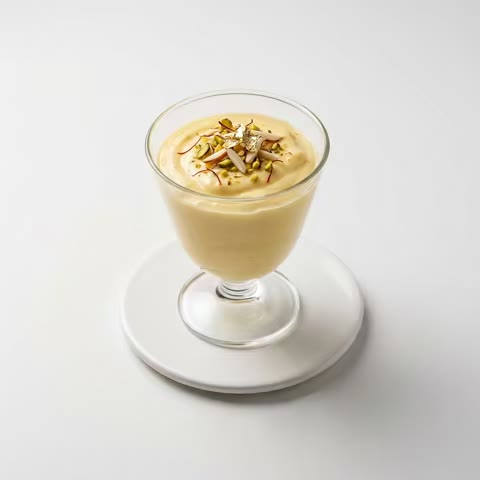
The classical shikharini — hung curd whipped with sugar, saffron and cardamom; celebrated in medieval texts as delicious, nourishing and decidedly heavy.
Traditional Preparation (Samskara)
Curd hung until thick, whisked with sugar and aromatics. A summer-midday festival dish; classical texts pair rich curd sweets with hot fried breads to offset the cold heaviness.
Classical Provenance: Bhojanakutuhala (shikharini); Gujarati / Maharashtrian tradition.
Synergistic Combinations (Samyoga)
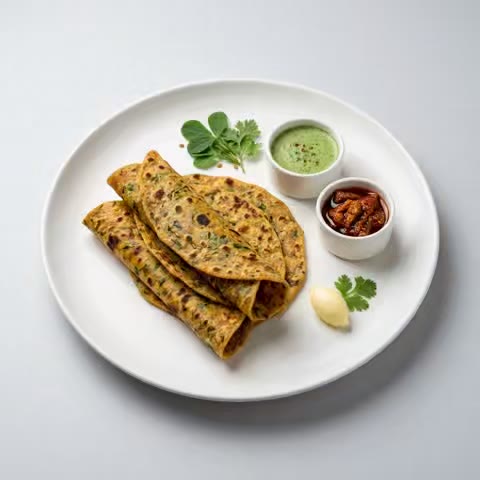
- with hot puri (Gujarati festival pairing — the heat balances the cold)
- saffron, cardamom, charoli nuts
- mango pulp version (amrakhand) in season
Contraindications & Viruddha Āhāra (Food Incompatibilities)
- Contraindication: kapha excess / congestion
- Contraindication: colds, asthma, sinusitis
- Contraindication: diabetes
- Contraindication: weak agni
- Incompatible pairing (Viruddha): curd preparations at night
- Incompatible pairing (Viruddha): with fish at the same meal
Verified USDA Nutrition Facts for Shrikhand
Complete macronutrient, vitamin, and mineral profile per 100 grams and per 1/2 cup (120g):
| Nutrient | Per 100g | Per Serving (1/2 cup) |
|---|---|---|
| Energy (Calories) | 273 kcal | 328 kcal |
| Protein | 7.7 g | 9.2 g |
| Total Carbohydrates | 41.4 g | 49.7 g |
| Dietary Fiber | 0.09 g | 0.1 g |
| Total Sugars | 38.1 g | 45.7 g |
| Total Fat | 9.0 g | 10.8 g |
| Calcium | 255.6 mg | 306.7 mg |
| Iron | 0.07 mg | 0.08 mg |
| Magnesium | 22.9 mg | 27.4 mg |
| Phosphorus | 202.7 mg | 243.2 mg |
| Potassium | 333 mg | 399 mg |
| Sodium | 84 mg | 101 mg |
| Zinc | 0.89 mg | 1.07 mg |
| Copper | 0.01 mg | 0.01 mg |
| Manganese | 0.10 mg | 0.12 mg |
| Selenium | 4.6 µg | 5.5 µg |
| Vitamin C | 1.1 mg | 1.3 mg |
| Vitamin A (RAE) | 96.0 µg | 115.2 µg |
| Vitamin E | 0.12 mg | 0.14 mg |
| Vitamin K | 0.4 µg | 0.5 µg |
| Thiamin (Vitamin B1) | 0.11 mg | 0.13 mg |
| Riboflavin (Vitamin B2) | 0.49 mg | 0.59 mg |
| Niacin (Vitamin B3) | 0.27 mg | 0.33 mg |
| Vitamin B6 | 0.09 mg | 0.11 mg |
| Folate (DFE) | 14.0 µg | 16.8 µg |
| Choline | 30.4 mg | 36.5 mg |