Classical Ayurvedic Profile & Preparation
Mudga is the best of legumes in every classical ranking — the one pulse prescribed even to the sick, the weak and the recovering.
Traditional Preparation (Samskara)
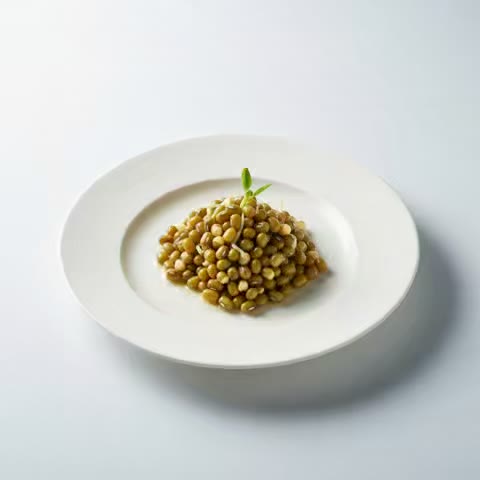
Soaked overnight; cooked whole or sprouted-and-steamed. The skin adds fiber the split dal lacks.
Classical Provenance: Charaka Samhita (mudga as best pulse); Bhavaprakasha Nighantu.
Synergistic Combinations (Samyoga)
- sprouted and steamed with lemon
- whole mung usal or sabut dal
- with rice as whole-mung kitchari
Contraindications & Viruddha Āhāra (Food Incompatibilities)
- Contraindication: raw sprouts in weak digestion (lightly steam instead)
Verified USDA Nutrition Facts for Whole mung bean
Complete macronutrient, vitamin, and mineral profile per 100 grams and per 1/4 cup dry (50g):
| Nutrient | Per 100g | Per Serving (1/4 cup dry) |
|---|---|---|
| Energy (Calories) | 294 kcal | 147 kcal |
| Protein | 22.5 g | 11.3 g |
| Total Carbohydrates | 46.1 g | 23.1 g |
| Dietary Fiber | 17.0 g | 8.5 g |
| Total Sugars | 0.5 g | 0.3 g |
| Total Fat | 1.1 g | 0.6 g |
| Calcium | 92.4 mg | 46.2 mg |
| Iron | 4.89 mg | 2.44 mg |
| Magnesium | 198.0 mg | 99.0 mg |
| Phosphorus | 353.0 mg | 176.5 mg |
| Potassium | 1177 mg | 588 mg |
| Sodium | 12 mg | 6 mg |
| Zinc | 2.67 mg | 1.33 mg |
| Copper | 1.00 mg | 0.50 mg |
| Manganese | 1.05 mg | 0.53 mg |
| Selenium | 23.3 µg | 11.7 µg |
| Vitamin C | 0 mg | 0 mg |
| Vitamin A (RAE) | 137.0 µg | 68.5 µg |
| Vitamin E | 0.33 mg | 0.17 mg |
| Vitamin K | 12.6 µg | 6.3 µg |
| Thiamin (Vitamin B1) | 0.45 mg | 0.23 mg |
| Riboflavin (Vitamin B2) | 0.27 mg | 0.14 mg |
| Niacin (Vitamin B3) | 2.16 mg | 1.08 mg |
| Vitamin B6 | 0.35 mg | 0.17 mg |