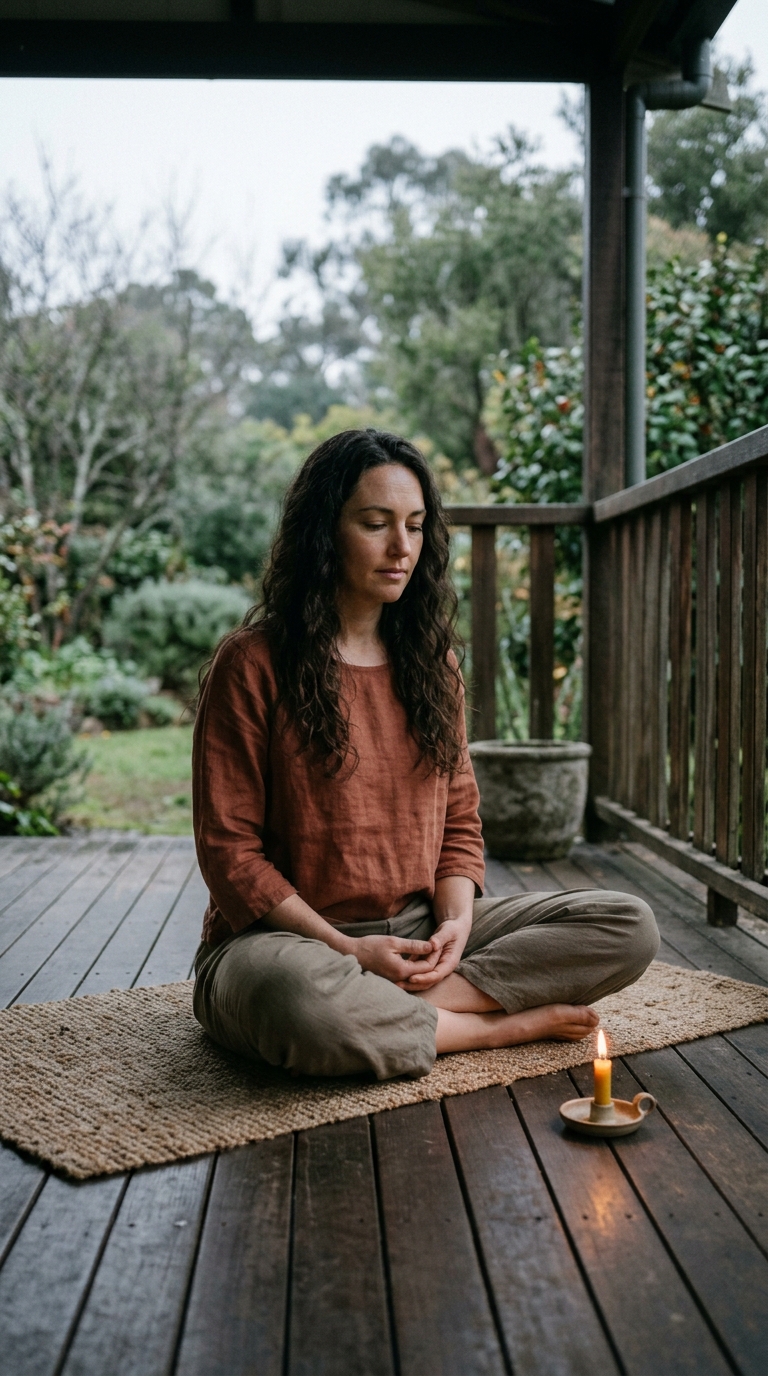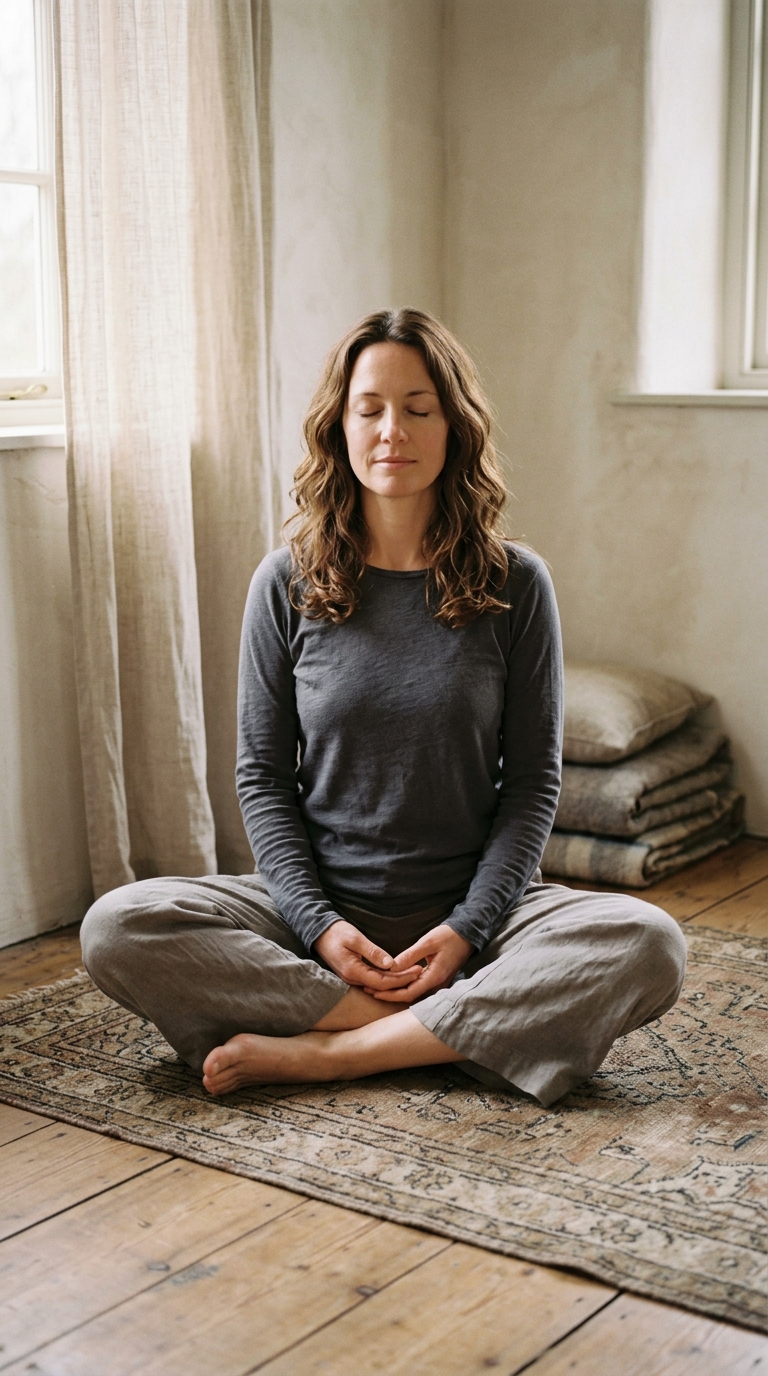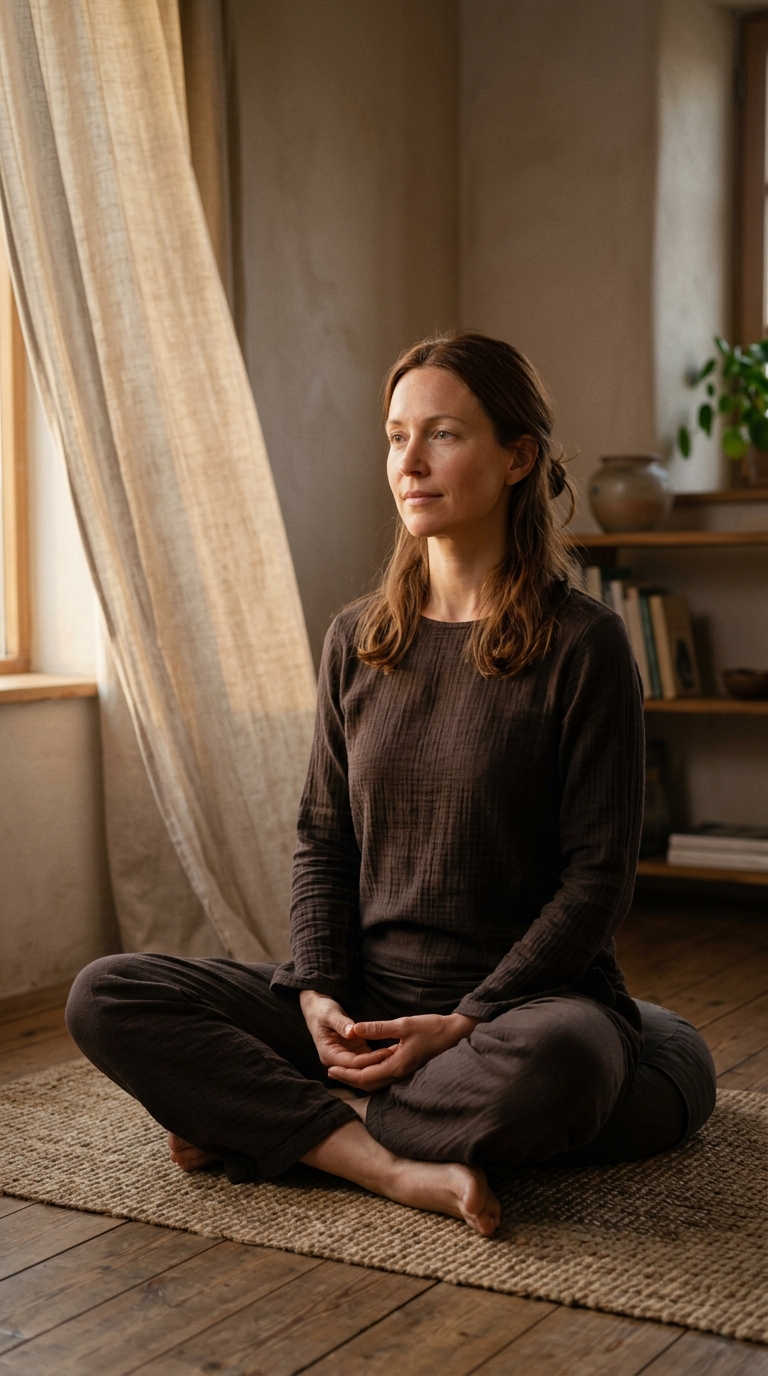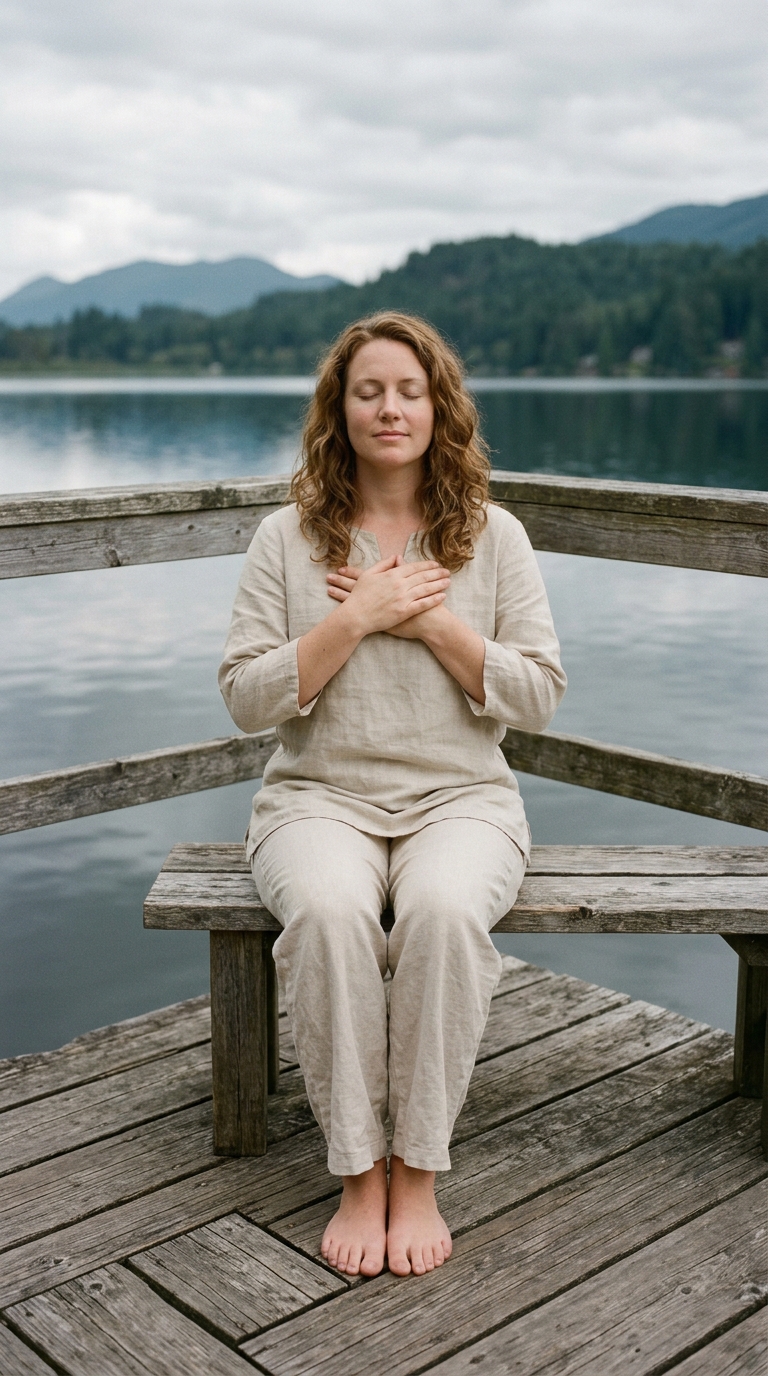
{'heading': 'Should you practice yoga in front of a mirror?', 'summary': 'A mirror can be useful for a brief 5-second geometry check in static standing poses (such as verifying front-knee tracking over the middle toes in Warrior II), but continuous mirror watching often rotates the cervical spine under load and trains you to judge poses by external shape rather than joint sensation and breath.', 'bullets': ['Neck safety: Turning your head 60–90° to look at a side mirror during Downward Dog, Plank, or Forward Bends introduces asymmetrical cervical load.', 'Proprioception vs. vision: Relying on a moving reflection in a mirror makes single-leg balances harder than fixing your eyes on a stationary matte point (`drishti`).', 'Anatomical individuality: Two skeletons with different femoral neck angles or torso-to-arm proportions will never look identical in the mirror when properly aligned.', 'Better self-check method: Use tactile landmarks (hands on iliac crests, heel-to-arch foot line on the mat) or a 10-second side-angle phone clip reviewed after the pose.']}
A mirror can be useful for a brief 5-second geometry check in static standing poses (such as verifying front-knee tracking over the middle toes in Warrior II), but continuous mirror watching often rotates the cervical spine under load and trains you to judge poses by external shape rather than joint sensation and breath.
Neck safety: Turning your head 60–90° to look at a side mirror during Downward Dog, Plank, or Forward Bends introduces asymmetrical cervical load.
Proprioception vs. vision: Relying on a moving reflection in a mirror makes single-leg balances harder than fixing your eyes on a stationary matte point (`drishti`).
Anatomical individuality: Two skeletons with different femoral neck angles or torso-to-arm proportions will never look identical in the mirror when properly aligned.
Better self-check method: Use tactile landmarks (hands on iliac crests, heel-to-arch foot line on the mat) or a 10-second side-angle phone clip reviewed after the pose.
Why Continuous Mirror Watching Distorts Cervical Alignment and Balance
In many gym studios and home exercise corners, wall mirrors are placed to the side or front of the mat. When you move through multi-planar yoga postures—such as Downward-Facing Dog (Adho Mukha Svanasana), Side Angle (Utthita Parsvakonasana), Revolved Lunge, or Bridge Pose—your head and torso continuously change orientation relative to the room. Cranking the neck sideways or upward to see your reflection forces the cervical spine out of axial alignment right when the shoulder girdle and upper trapezius are bearing load.
Mirror gazing also interferes with the vestibular-ocular reflex during standing balances like Tree Pose (Vrksasana) or Warrior III (Virabhadrasana III). When you watch your own reflection swaying in a mirror, your visual field moves at double the amplitude of your postural sway, triggering overcorrections in the ankles and hips. Fixing your eyes on an unmoving spot on the floor or wall (`drishti`) provides a stable spatial anchor that calms postural oscillation.
- Never rotate the neck under axial load: Keep the ears in line with the upper arms or neutral spine during Bridge, Shoulder Stand prep, Plank, and Downward Dog.
- Avoid hyperextending the neck in forward folds: Looking forward into a front mirror during Uttanasana or Prasarita Padottanasana compresses the posterior cervical spine.
- Balance anchor rule: If a mirror sits directly in front of your mat, gaze at a stationary floor tile or baseboard 1.5 to 2 meters ahead rather than at your own eyes.
Proprioception and Interoception: What a Mirror Cannot Show
Yoga is designed to train two internal sensory systems: proprioception (sensing joint position, muscular tension, and weight distribution across the soles of the feet and hands) and interoception (sensing breath depth, heart rate, diaphragmatic ease, and nervous-system effort). A mirror only displays two-dimensional silhouette geometry—it cannot tell you whether you are holding your breath, clenching your jaw, gripping your hip flexors, or hanging on a hyperextended knee.
Moreover, skeletal variation means that safe functional alignment rarely looks identical from person to person. Variations in acetabular (hip socket) orientation, femur-to-tibia length ratios, and humerus-to-torso proportions change how wide a stance should be and whether the heels touch the floor in Downward Dog. Copying an external visual ideal in a mirror frequently leads practitioners to round the lumbar spine just to make the hands look lower toward the floor.
- Foot-tripod awareness: Sense equal pressure across the base of the big toe, base of the little toe, and center of the heel without looking down.
- Pelvic neutral check: Place your thumbs on the posterior iliac spines and fingertips on the anterior hip bones (ASIS) to feel pelvic tilt directly with your hands.
- Breath quality check: If your nasal inhale becomes jerky or audible strain appears in the throat, back out of the posture by 10–15% regardless of how the pose looks.
When Brief Visual Feedback Is Genuinely Helpful—and How to Do It Safely
Visual feedback is not useless; motor-learning research shows that occasional external calibration helps correct habitual blind spots—such as a front knee collapsing inward (valgus) in Warrior II or shoulders hiking toward the ears in Plank. The key is separating the calibration check from the full practice session so you do not crane your neck mid-pose.
When learning a new standing posture at home, face the mirror directly so your neck stays neutral, check one specific landmark for five seconds (for example, whether the center of your patella tracks toward the second and third toes), then close your eyes or soften your gaze for three breaths to memorize what that alignment feels like internally. Next, turn your mat 90 or 180 degrees away from the mirror and reproduce the sensation through proprioception alone.
- One landmark at a time: Check front-knee tracking in Warrior II or hip levelness in Tree Pose while facing the mirror squarely.
- Bridge visual to kinesthetic: Immediately after seeing the adjustment, notice the muscular sensation in the outer hip or core so you can find it without a mirror.
- Post-session review for side-profile poses: For Plank or Downward Dog, prop your phone at mat level for a 10-second side clip and review it after finishing rather than turning your head during the hold.
Frequently Asked Questions
Why do most traditional yoga studios avoid wall mirrors?
Traditional Hatha, Ashtanga, and restorative spaces omit mirrors to prevent visual comparison between students, protect cervical spine alignment in non-forward-facing poses, and encourage internal focus (`pratyahara` and `drishti`).
How can I tell if my back is rounding in a forward fold without a mirror?
Place one hand flat across your sacrum and lower lumbar spine as you hinge forward with bent knees; the moment you feel the spinous processes poke outward into your palm, stop hinging and rest your hands on blocks.
What should I do if my home workout room has a fixed wall mirror?
Orient the head of your mat away from the mirror for most of your practice, or hang a lightweight sheet over the lower half of the glass during balance and floor sequences.