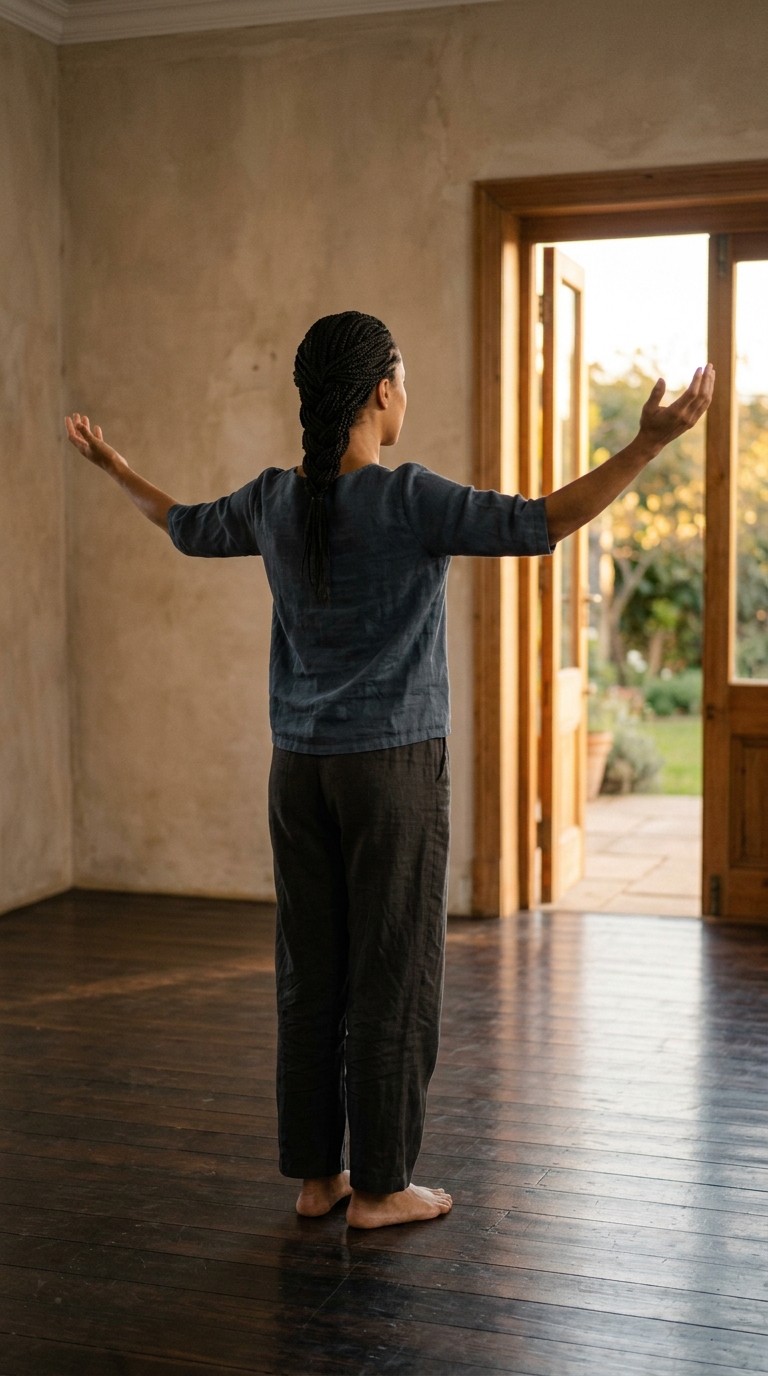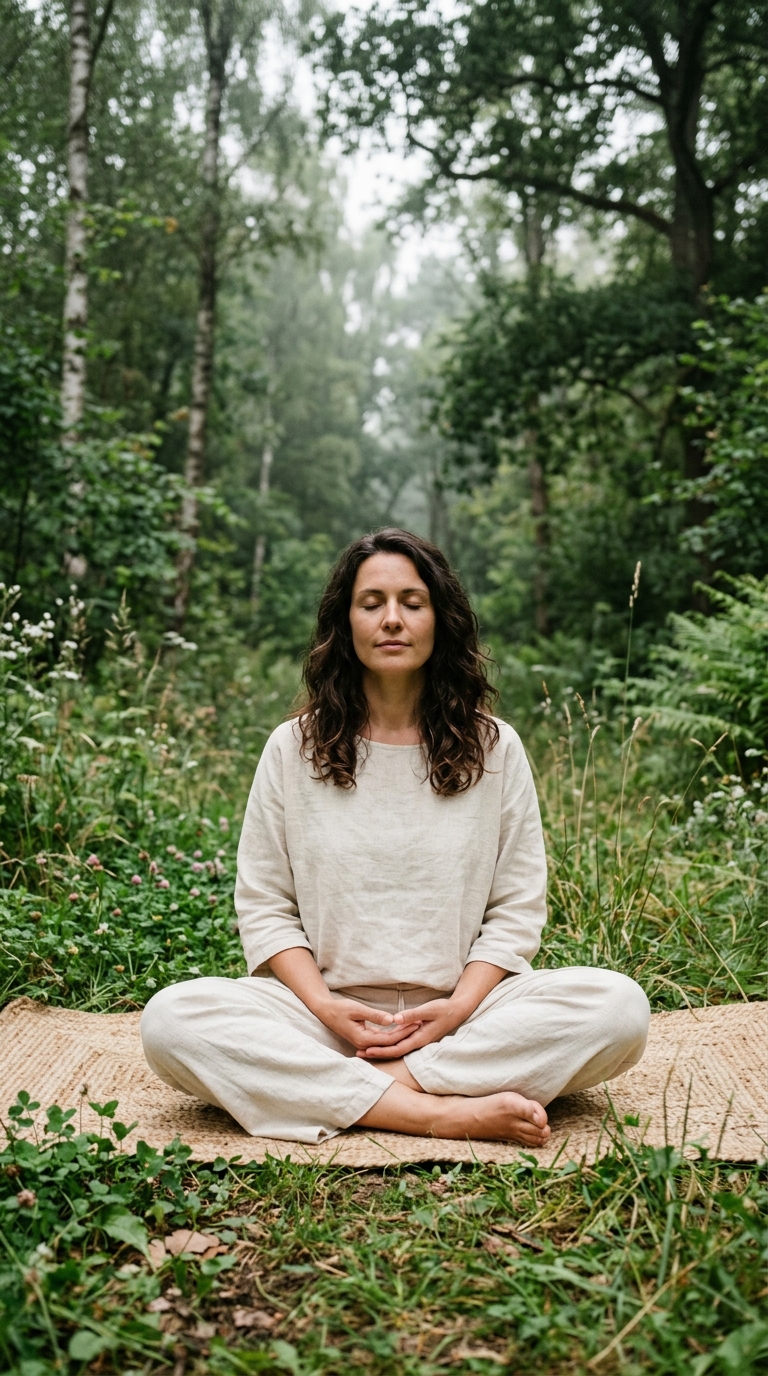
Beginners often hear two kinds of breathing instruction in a yoga class. One links breath to movement: 'inhale, lift the arms; exhale, fold forward'. The other uses breath as a clock: 'stay here for five breaths'. Neither is usually explained, and both can leave you wondering whether you are breathing wrong.
This guide covers what these instructions are for, the conventions behind them, and how to adapt them when they do not match your own breathing. It is about breathing during poses, not about separate breathing exercises (pranayama).
The basic aim: keep the breath going
The most useful breathing instruction in a beginner class is simply not to hold your breath. When a pose takes effort or concentration, many people hold the breath without noticing. If you catch yourself doing it, breathe out, then let the breath continue at whatever pace is comfortable.
The Yoga Sutras describe posture as steady and comfortable (II.46). A breath that keeps moving without strain is one of the clearest signs you are working at that level. If you cannot breathe smoothly in a pose, it is often a sign to ease off, use a prop or take a simpler version.
Common conventions for linking breath to movement
Many styles follow a broad pattern. These are teaching conventions, not physiological rules, and teachers vary.
- Inhale for movements that lift, lengthen, open the chest or bend backward: raising the arms, coming up to standing, lifting the chest.
- Exhale for movements that fold, twist, lower or round: folding forward, turning into a twist, lowering to the floor.
- During holds, breathe steadily. Some teachers suggest lengthening the spine on the inhale and settling into the pose on the exhale.
- In transitions that do not fit neatly, such as stepping a foot forward, take an extra breath. A spare breath is better than a rushed move.
When the cue does not match your breath
In a flowing class the teacher sets one pace for everyone, but breath length varies between people and from day to day. If the cues are faster than your breath, you have three reasonable choices: take extra breaths and rejoin at the next pose, move through the sequence at your own breath pace, or rest and wait. Rushing a movement to fit a breath you have not finished is the least useful option.
You can also reverse a cue if it feels wrong for you on a given movement. The convention exists to keep breath and movement together, not to make you breathe against your body.
Nose or mouth?
Many styles teach breathing through the nose during poses, and some add the soft throat sound of ujjayi. That is a common convention, not a requirement. In demanding poses, in warm rooms, or with a blocked nose, you may need more air than the nose comfortably allows. Breathing through the mouth then is a practical choice, not a mistake.
If you find you regularly need to breathe through the mouth in a particular class, it can be a sign that the pace or intensity is higher than suits you that day.
'Five breaths' or thirty seconds? Timing holds
Counting breaths is a convenient timer: you do not need a clock, and the count naturally adjusts to your pace. But a breath is not a fixed unit. As an illustration, five breaths could take around 15 seconds for one person and 40 for another, and the same person may breathe faster when a pose is hard.
That has a practical consequence. If a pose feels difficult, your breath tends to speed up, so five breaths pass more quickly. If you are relaxed, they slow down. Breath counts therefore loosely scale the hold to how you are coping, which is part of their appeal.
Seconds are more consistent. A timer or recording that holds a pose for 30 seconds holds it for 30 seconds regardless of how you are breathing. That is useful if you want to keep holds even on both sides or compare sessions, but it does not adjust when you are struggling.
- Use breath counts when you want holds to follow how you feel, and you are practising without a timer.
- Use seconds when you want consistency, such as keeping left and right sides equal or tracking a hold over time.
- Whichever you use, do not slow your breathing deliberately to make a hold last longer or to reach a count; that turns the pose into a breath-holding exercise.
- If a recording uses seconds and you prefer breaths, notice roughly how many breaths fit and let that guide you.
When breathing is a reason to stop
Breathlessness you cannot settle by resting, lightheadedness, chest pain or pressure are reasons to stop the session, not to adjust your breathing technique. Seek medical help for chest pain or symptoms that do not settle.
NCCIH describes yoga as generally safe for healthy people when performed properly under a qualified instructor, and notes that some conditions call for modifications. If you have a heart or lung condition, ask your clinician what level of effort is appropriate.
Sources & Classical References
- Patanjali's Yoga Aphorisms, translated by Swami Vivekananda (1896), Wikisource — Public-domain translation of Yoga Sutra II.46 on steady, comfortable posture.
- NCCIH: Yoga: Effectiveness and Safety — General safety guidance and conditions that may require modifications.
- MedlinePlus: Chest pain — Chest pain symptoms that warrant emergency care.