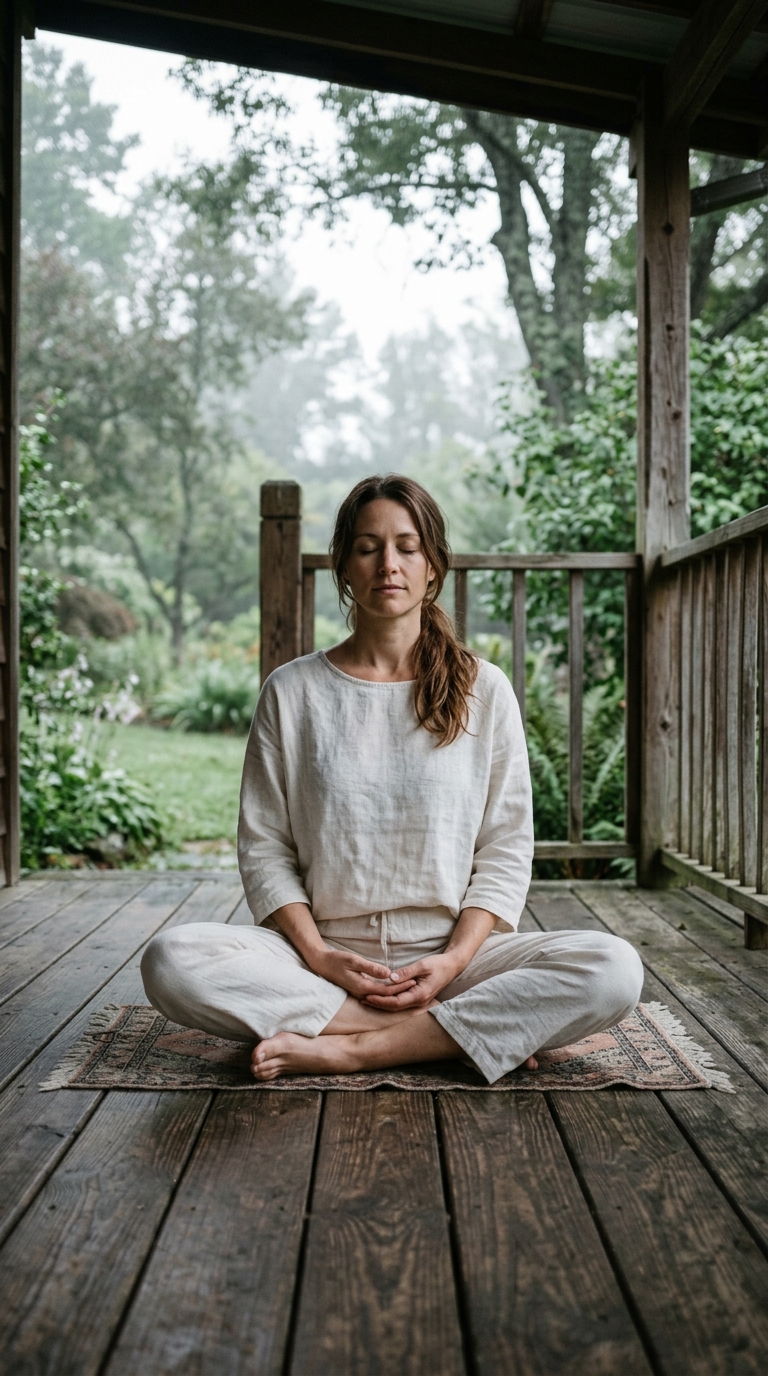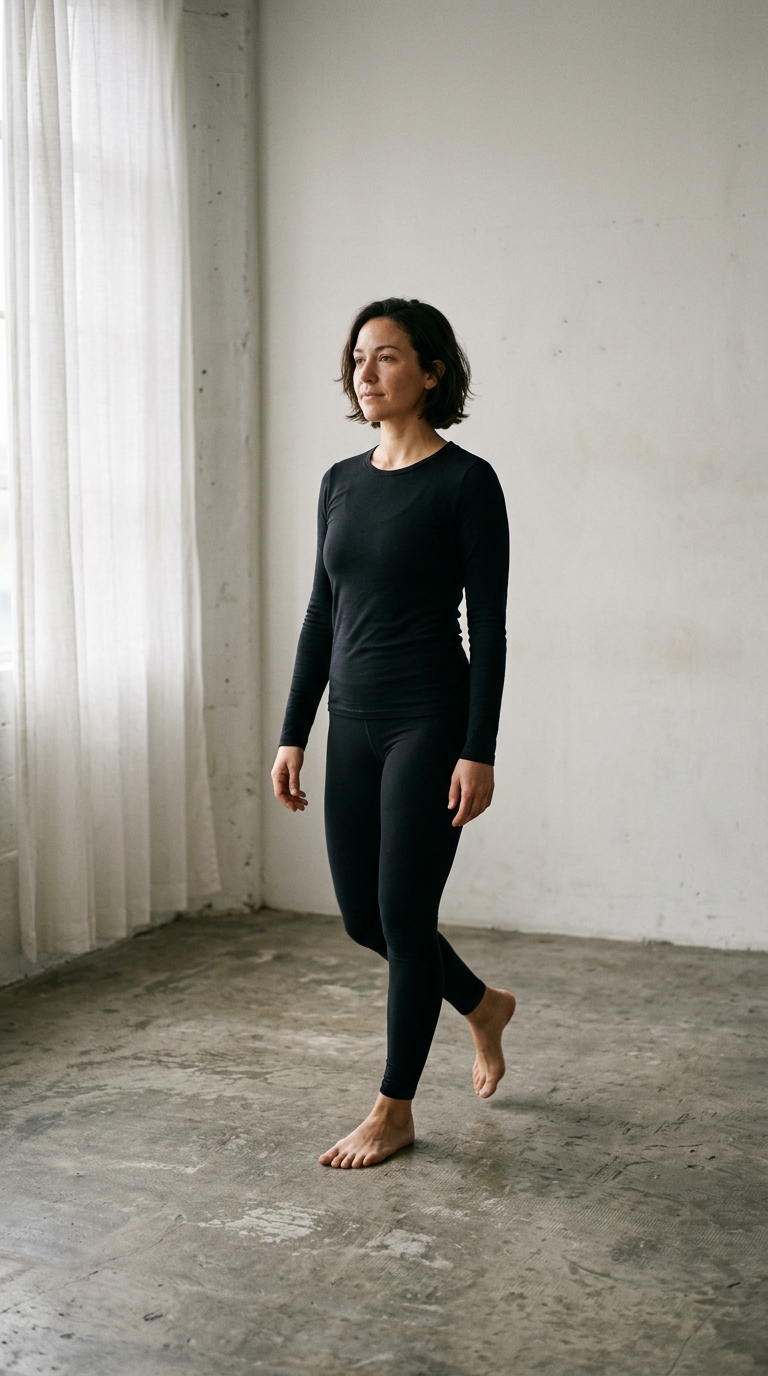
Drishti is the Sanskrit term yoga teachers use for a gaze point: the place you rest your eyes during a pose or a seated practice. A teacher might say 'drishti to the hand' in a standing pose, or 'soft gaze at the tip of the nose' in meditation.
This guide explains where the idea comes from, the gaze points commonly taught today, the practical reason a steady gaze helps in balancing poses, and how to adapt gaze instructions when they strain your neck or eyes.
Gaze in the classical texts
Instructions about where to direct the eyes are old, but they are few. The Bhagavad Gita (6.13) describes the meditator gazing at the tip of the nose. The fifteenth-century Hatha Yoga Pradipika gives the same nose-tip gaze for lotus pose and lion pose, and in its fourth chapter describes shambhavi mudra as keeping the sight directed outward without blinking while attention rests inward.
These are instructions for seated practice and meditation. The idea of a specific gaze point for every pose is much more recent.
The nine gaze points of modern Ashtanga
In the Ashtanga vinyasa system associated with K. Pattabhi Jois, each pose has an assigned drishti. Teaching literature in that tradition usually lists nine (spellings of the Sanskrit names vary between sources; the forms below follow the Wikipedia overview cited at the end):
- Nasagre: tip of the nose.
- Bhrumadhye: between the eyebrows.
- Nabhicakre: the navel.
- Hastagrahe: the hand.
- Padayoragre: the toes.
- Parshva (right): far to the right.
- Parshva (left): far to the left.
- Angushthamadhye: the thumbs.
- Urdhva: upward.
Why a steady gaze helps balance
Standing balance draws on three sources of information: vision, the inner ear's balance system, and proprioception, the sense of where your body is. That is why balance gets harder with the eyes closed; clinicians use this in the Romberg test. A fixed visual reference gives the brain a stable cue, and moving the eyes or head around removes it. This is one practical reason teachers ask for a steady gaze in balancing poses, regardless of the tradition behind it.
In flowing practice, an assigned gaze also keeps the head in line with the spine and reduces the habit of looking around the room. Many teachers present drishti as a way of practising attention: the eyes stay put, and so does the mind. That is a traditional and teaching rationale, not a measured effect.
Adapting gaze instructions
A prescribed gaze can be the wrong choice for your neck or eyes. The gaze point serves the pose; it should not force the head into a position that strains.
- Looking up (urdhva) strains the neck: look straight ahead instead, or at a point slightly above eye level.
- Looking at the tip of the nose causes eye strain or headache: soften the gaze to the floor a little in front of you.
- Looking to the side in a twist pulls the neck further than the spine has turned: keep the head facing the same direction as the chest.
- Gazing upward in a standing balance makes you wobble: look at a fixed point on the floor or wall at eye level, and use a wall or chair for support.
- You wear glasses or have reduced vision: a 'soft' gaze, resting the eyes without focusing hard, works for any drishti.
A simple way to practise
The basic skill is choosing a still point and returning the eyes to it.
- Before a standing balance, choose a point that is not moving: a mark on the floor a short distance ahead, or a spot on the wall at eye level.
- Look at it softly, without staring or straining.
- Keep the gaze there as you come into the pose and while you hold it.
- If you wobble, notice whether the eyes moved first. Return them to the point.
- In seated meditation with eyes open, rest the gaze on the floor a little in front of you, slightly downward and unfocused.
Gaze and screens
Following a video means looking at a screen, which often pulls the head out of the gaze a pose calls for. Learning the poses well enough to follow by audio, or placing the screen where you only need to glance at it, lets you keep a steady gaze in the pose itself.
Sources & Classical References
- Hatha Yoga Pradipika, translated by Pancham Sinh (1914), chapter 1 — Public-domain translation including the nose-tip gaze in lotus and lion poses.
- Hatha Yoga Pradipika, translated by Pancham Sinh (1914), chapter 4 — Public-domain translation including the description of shambhavi mudra.
- Wikipedia: Drishti (yoga) — Overview of the gaze points used in Ashtanga vinyasa yoga and earlier textual references, with citations to Ashtanga teaching literature.
- Wikipedia: Romberg's test — Explains the contributions of vision, vestibular function and proprioception to standing balance.