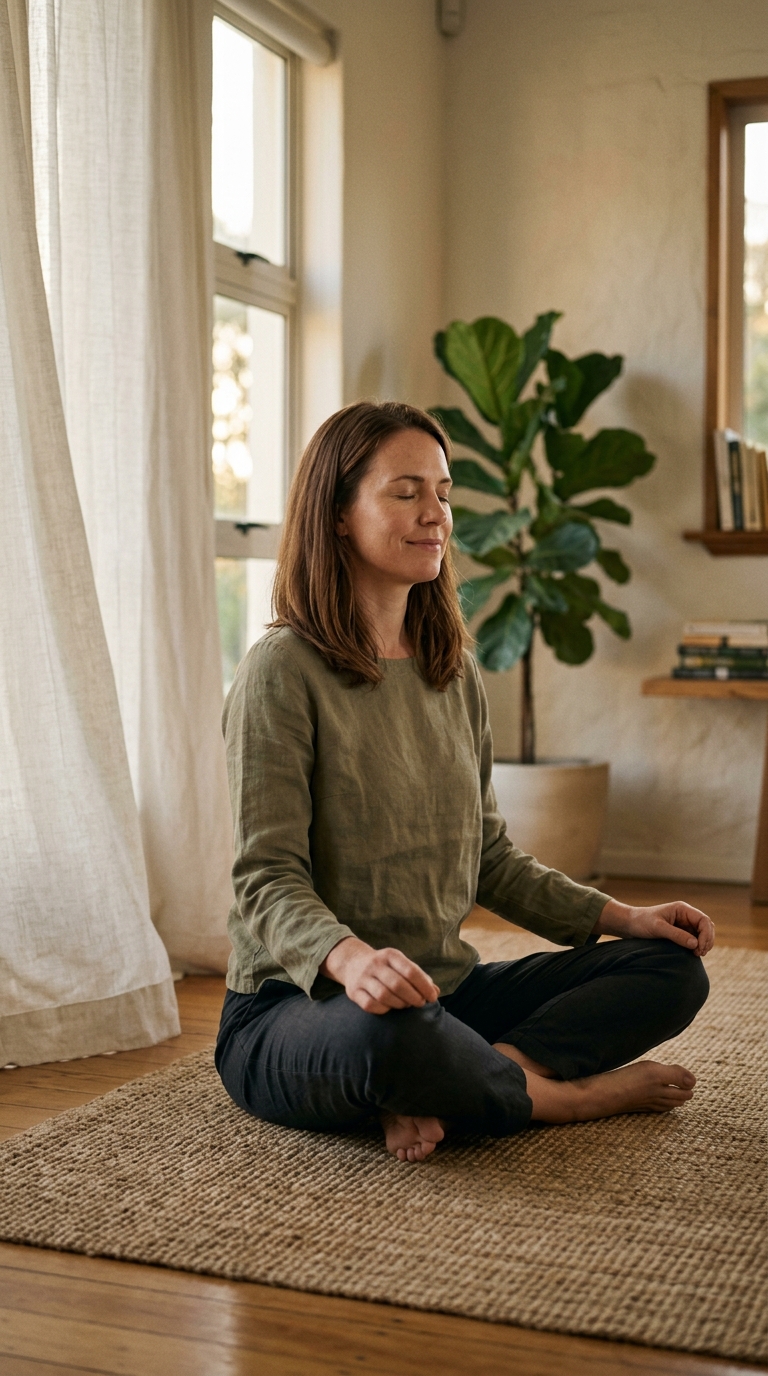
{'heading': 'Self-guided yoga vs. following a led class', 'summary': 'A led class removes decision fatigue, introduces unfamiliar transitions, and provides external accountability—making it ideal when learning alignment fundamentals or when mental energy is low. A self-guided practice lets your own breath length, joint feedback, and daily schedule dictate hold times and prop adjustments without rushing to match a group tempo.', 'bullets': ["Pacing control: In a led class, everyone moves on the instructor's cadence; in self-guided practice, you can stay an extra three breaths on a tight hip or skip a pose entirely.", 'Cognitive shift: Led classes rely on auditory processing; self-guided sessions cultivate internal memory and interoceptive quiet.', 'Overcoming "blank mat syndrome": Write a fixed 5-to-7-pose core sequence on an index card or save a custom workout in the app so you never have to invent a class on the spot.', 'Hybrid approach: Use led classes to learn new mechanics and self-guided sessions 2–3 times a week to consolidate them at your own pace.']}
A led class removes decision fatigue, introduces unfamiliar transitions, and provides external accountability—making it ideal when learning alignment fundamentals or when mental energy is low. A self-guided practice lets your own breath length, joint feedback, and daily schedule dictate hold times and prop adjustments without rushing to match a group tempo.
Pacing control: In a led class, everyone moves on the instructor's cadence; in self-guided practice, you can stay an extra three breaths on a tight hip or skip a pose entirely.
Cognitive shift: Led classes rely on auditory processing; self-guided sessions cultivate internal memory and interoceptive quiet.
Overcoming "blank mat syndrome": Write a fixed 5-to-7-pose core sequence on an index card or save a custom workout in the app so you never have to invent a class on the spot.
Hybrid approach: Use led classes to learn new mechanics and self-guided sessions 2–3 times a week to consolidate them at your own pace.
What a Led Class Does Best—and Where It Creates Friction
Following a live teacher or a led audio/video session solves the hardest barrier for many practitioners: deciding what to do next. A skilled instructor sequences warm-ups, standing postures, counter-poses, and Savasana into a cohesive arc while offering alignment reminders you might forget on your own. After a demanding workday, simply stepping onto the mat and following spoken cues eliminates planning friction.
However, led instruction always operates on an external clock. An instructor leading a room—or recording a class—must choose a single breath cadence and transition speed. If your lungs are larger or smaller than average, or if you need 15 extra seconds to arrange a folded blanket under your knees and two blocks under your hands in Low Lunge, a brisk led tempo can make you feel perpetually behind, tempting you to skip prop setups that protect your joints.
- Best uses for led classes: Learning unfamiliar pose families, discovering blind-spot alignment habits, and practicing when you feel too tired to plan.
- Common led-class friction: Rushing transitions before props are placed, matching someone else's breath rate, and staying in a posture that does not suit your joints today.
- Permission to pause: Even inside a led class, pausing for an extra breath to set up a block or taking Child's Pose is safer than rushing to catch up.
Why Self-Guided Practice Builds Deeper Proprioceptive Skill
In traditional Mysore-style Ashtanga and personal Hatha sadhana, students memorize a structured sequence and move through it silently at the pace of their own nasal breath while a teacher offers individual adjustments as needed. Practicing without continuous external narration shifts the brain from listening and reacting to sensing and regulating.
When you guide your own session, asymmetrically tight tissues can receive an extra three breaths of patience, and you can linger in the transition between poses to check foot tripod pressure or scapular stability. You also gain complete schedule flexibility: a self-guided practice does not have to be a 60-minute production—it can be a focused 12-minute morning mobilization or a 15-minute evening restorative sequence.
- True breath-led tempo: Your inhale and exhale determine when a movement starts and finishes.
- Zero prop-setup rush: Take as long as needed to fold a blanket, adjust a strap loop, or move a chair against the wall.
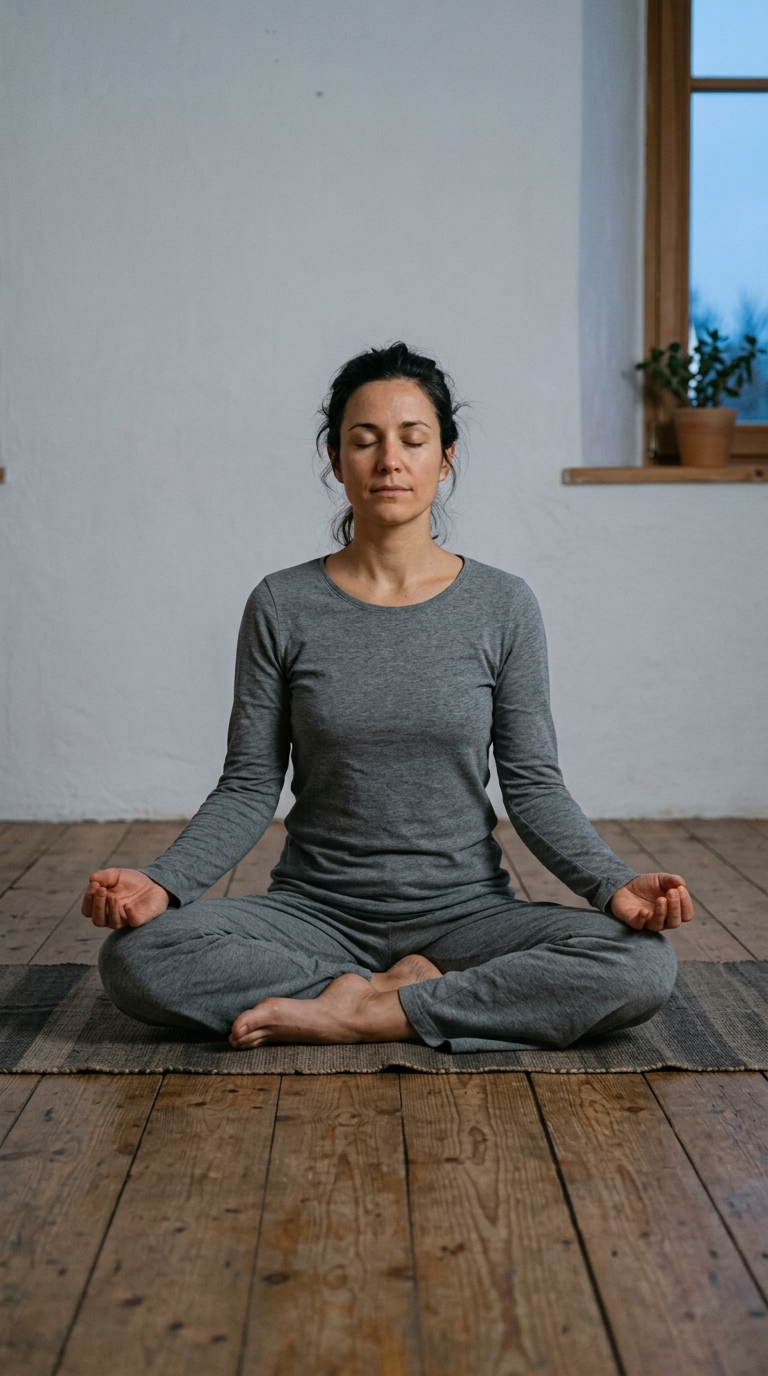
- Auditory quiet: Practicing without constant verbal stream allows deeper concentration (`dharana`) and nervous-system settling.
A Three-Step Bridge from Led Instruction to Self-Guided Practice
Many practitioners try to start self-guided yoga by unrolling a mat with no plan, sitting down, and wondering what pose to do after Cat–Cow—a frustrating experience known as "blank mat syndrome." Autonomy is much easier when you separate sequence design from practice time.
Start with a short, fixed "anchor sequence" of six poses that cover the primary spinal directions: (1) Cat–Cow (flexion/extension), (2) Downward Dog or Puppy Pose (axial lengthening), (3) Low Lunge with a gentle twist (hip extension + rotation), (4) Warrior II to Triangle (lateral flexion + standing strength), (5) Bridge Pose (supine hip/thoracic extension), and (6) Supine Twist into Savasana. In `Ayurveda & Asana Yoga`, you can also practice any guided session with `Guided voice` enabled while learning the script, then switch the `Guide` picker in `Practice Details` to `No voice` once you want silent, self-paced practice with only optional ambient sound.
- Stage 1 (Guided memorization): Repeat the same 15-to-20-minute sequence 4 to 5 times with voice cues until the pose order feels automatic.
- Stage 2 (Index-card or `No voice` mode): Write the 6–8 pose names on a card beside your mat or switch `Practice Details` to `No voice` with a gentle timer.
- Stage 3 (Adaptive customization): Keep the same 6-pose skeleton, swapping one standing or floor posture based on your daily energy and logging a quick note afterward.
Frequently Asked Questions
Is it safe for a beginner to practice self-guided yoga at home?
Yes, provided you stick to foundational postures you have already learned with clear alignment instructions, use props generously, and avoid forcing end-range stretches or unsupported inversions.
How do I keep from cutting my Savasana short when practicing on my own?
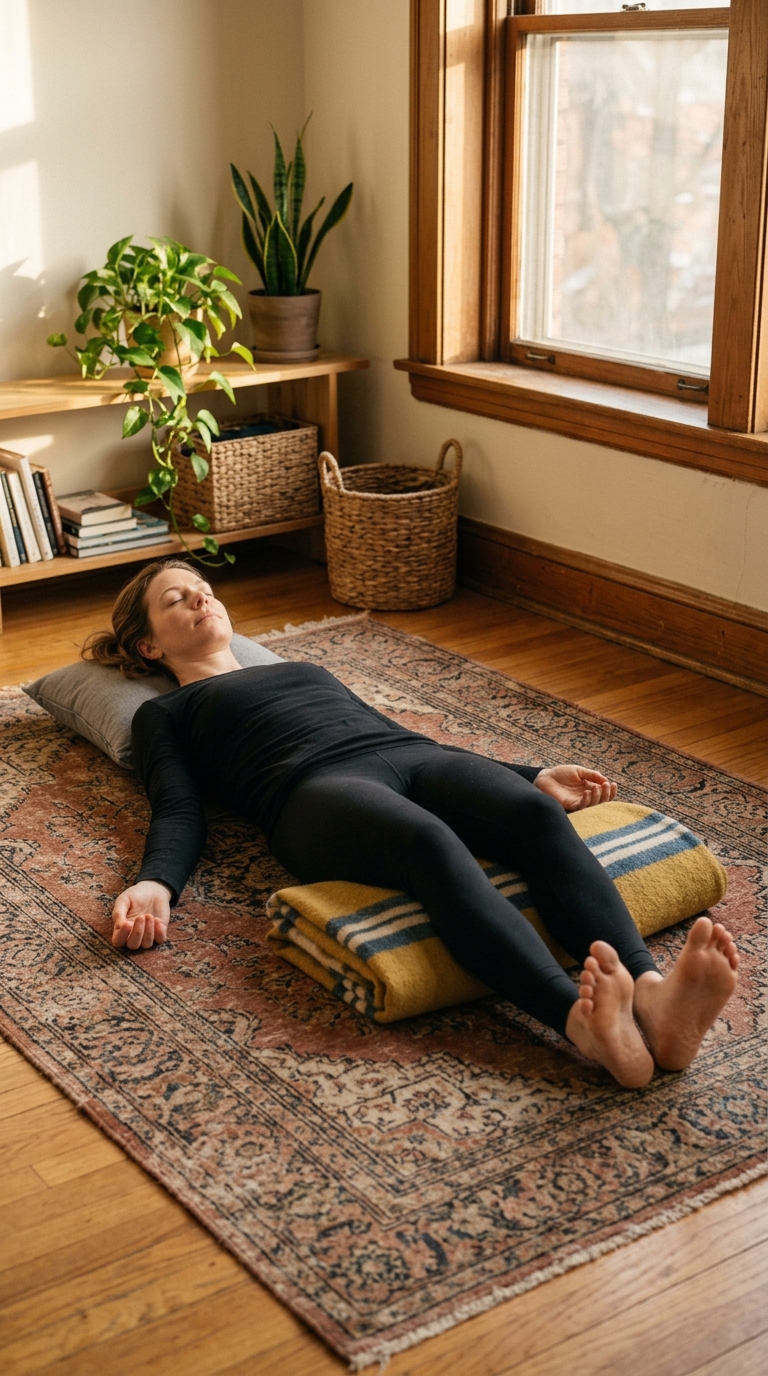
Always set a soft bell timer for 3 to 5 minutes before lying down for Savasana; without a timer, two minutes of silence in self-guided practice often feels like ten, causing people to jump up early.
Should I do the exact same sequence every day in self-guided practice?
Keeping a consistent warm-up and closing sequence saves mental energy, while alternating your middle standing or mobility block between strength days and restorative days prevents repetitive-load fatigue.