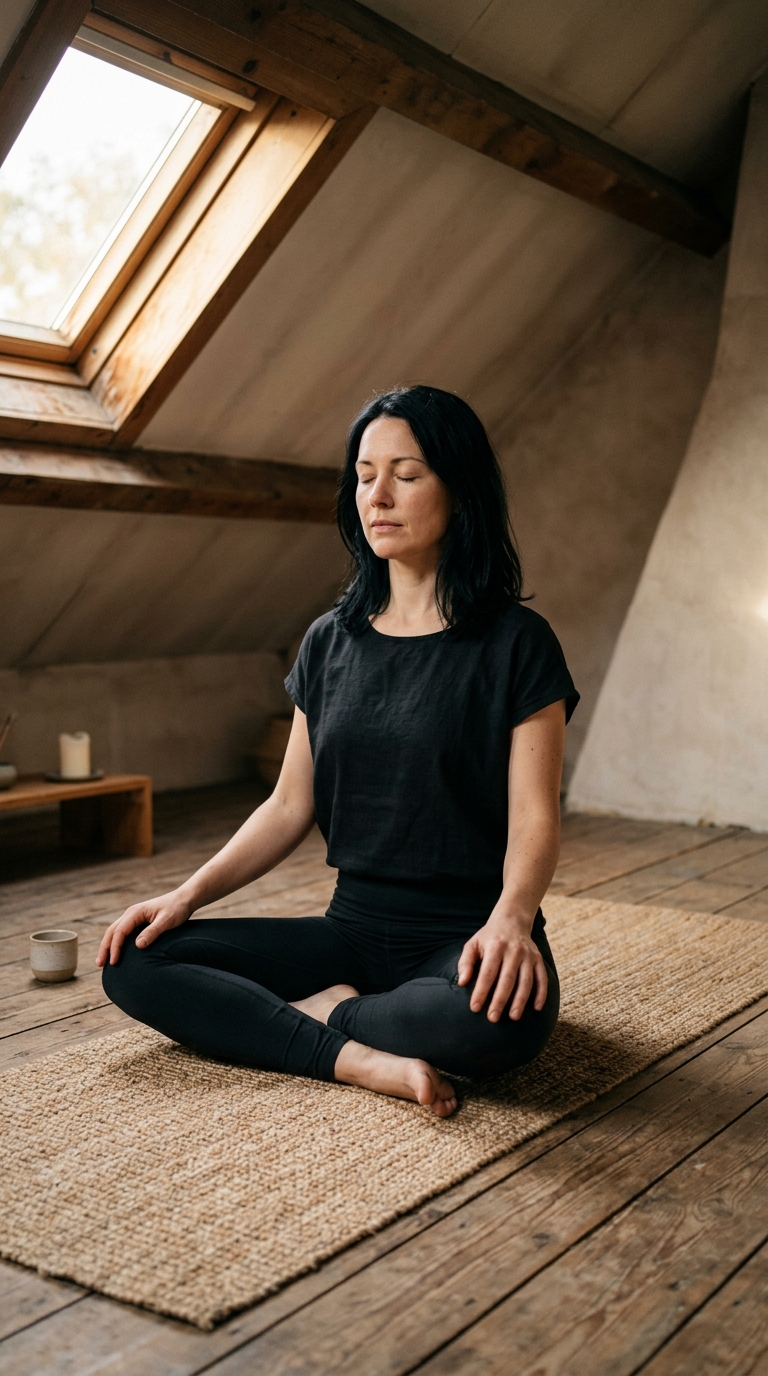
Pranayama is usually translated as breath control or breath regulation. In a modern class it might mean a few minutes of slow breathing at the end of a session; in the classical texts it is one of the core disciplines of yoga, with detailed techniques and strong warnings about practising carelessly.
This guide explains where the word comes from, maps the main techniques by what they ask you to do, and separates what the traditional sources claim from what clinical research has actually tested.
Pranayama in the Yoga Sutras
Patanjali's Yoga Sutras list pranayama as the fourth of eight limbs of yoga, after ethical restraints, observances and posture (II.29). The definition comes right after the instruction that posture should be steady and comfortable (II.46). Once posture is established, Swami Vivekananda's 1896 translation reads, 'Controlling the motion of the exhalation and the inhalation follows' (II.49).
The next sutra (II.50) describes the breath as external, internal or motionless, regulated by place, time and number, and long or short. Put simply: Patanjali is interested in where the breath is held, for how long and for how many rounds. He does not describe named techniques. Those come later.
Pranayama in the hatha yoga texts
The fifteenth-century Hatha Yoga Pradipika gives pranayama a whole chapter. Its reasoning is stated plainly in Pancham Sinh's 1914 translation: when respiration is disturbed the mind becomes disturbed, and by restraining respiration the yogi gains steadiness of mind (2.2).
The same chapter is emphatic about caution. It compares the breath to lions, elephants and tigers that must be tamed slowly, 'otherwise it kills the practiser himself' (2.15), and says improper practice generates diseases (2.16). It also makes sweeping promises — that proper practice eradicates all diseases — which are traditional claims, not findings anyone has tested.
The text names eight kumbhakas, or breath-retention practices: Surya Bhedana, Ujjayi, Sitkari, Sitali, Bhastrika, Bhramari, Murchha and Plavini (2.44). In this tradition, retaining the breath is central; many modern classes leave retention out or keep it brief.
A practical map of common techniques
Modern classes use a smaller set of techniques. A useful way to compare them is by what each asks you to change.
- Awareness only: noticing the breath without changing it. Often taught first; not pranayama in the classical sense, but a common starting point.
- Pace and proportion: slow, even breathing, or a longer exhale than inhale. Changes timing without unusual effort.
- Route: alternate nostril breathing (often called nadi shodhana), where one nostril is closed at a time.
- Sound and resistance: ujjayi, with a slight narrowing in the throat; bhramari, humming on the exhale.
- Cooling-style breaths: sitali and sitkari, where air is drawn in through the curled tongue or the teeth.
- Retention: kumbhaka, deliberately pausing after the inhale or exhale.
- Forceful or rapid breathing: kapalabhati and bhastrika, with strong, quick exhales or breaths. These are the techniques most often taught with explicit cautions, and NCCIH advises people new to yoga to avoid forceful breathing.
Choosing where to start
The list above runs roughly from the least to the most change from ordinary breathing. Beginners in most modern traditions start near the top and stay there for some time. That fits the Hatha Yoga Pradipika's emphasis on gradual progress, and it also fits common sense: the further a technique moves you from normal breathing, the more likely it is to cause lightheadedness or tingling, and the more it benefits from a teacher who can see what you are doing.
If you have a heart or lung condition, high blood pressure, are pregnant, or have a history of panic or trauma, it is reasonable to ask a clinician before practising techniques with retention or forceful breathing.
What modern research shows
There is a substantial body of research on yogic breathing, but its quality is limited. A 2019 narrative review by Saoji and colleagues concluded that studies on yogic breathing lack methodological rigour and that larger, better-designed studies are needed. It judged the practices generally safe when done under a trained teacher, while noting a reported case of lung injury linked to kapalabhati. A 2018 systematic review of slow-breathing studies by Zaccaro and colleagues found none used randomised controlled designs and could not pool results because the studies differed so much.
Individual techniques have been studied for specific measures, such as blood pressure for alternate nostril breathing, but the authors of those reviews generally call for higher-quality trials. The fair summary is that pranayama is a long-standing traditional practice with plausible effects on relaxation and attention, and limited, low-certainty clinical evidence for any particular health outcome.
Keeping tradition and evidence separate
Traditional texts describe pranayama in terms of prana (vital energy), nadis (channels) and purification. These ideas are part of the philosophy and the practice, and worth learning on their own terms. They are not anatomical or physiological descriptions, and the health claims made for them in the texts have not been confirmed by clinical research.
When a teacher or app says a technique 'balances', 'detoxifies' or 'treats' something, it helps to ask whether that is a traditional description or a tested clinical claim. Both can be meaningful; they are different kinds of statement.
Sources & Classical References
- Patanjali's Yoga Aphorisms, translated by Swami Vivekananda (1896), Wikisource — Public-domain translation of Yoga Sutras II.29, II.46, II.49 and II.50.
- Hatha Yoga Pradipika, translated by Pancham Sinh (1914), chapter 2 — Public-domain translation of the chapter on pranayama. Verse numbers in this edition can differ by one or two from other editions.
- Saoji, Raghavendra and Manjunath (2019), Effects of yogic breath regulation: a narrative review of scientific evidence — Summary of research on yogic breathing, its methodological limits and safety observations.
- Zaccaro et al. (2018), How breath-control can change your life: a systematic review on psycho-physiological correlates of slow breathing — Systematic review noting the absence of randomised designs and the heterogeneity of slow-breathing studies.
- NCCIH: Yoga: Effectiveness and Safety — Advice for people new to yoga to avoid extreme practices, including forceful breathing.