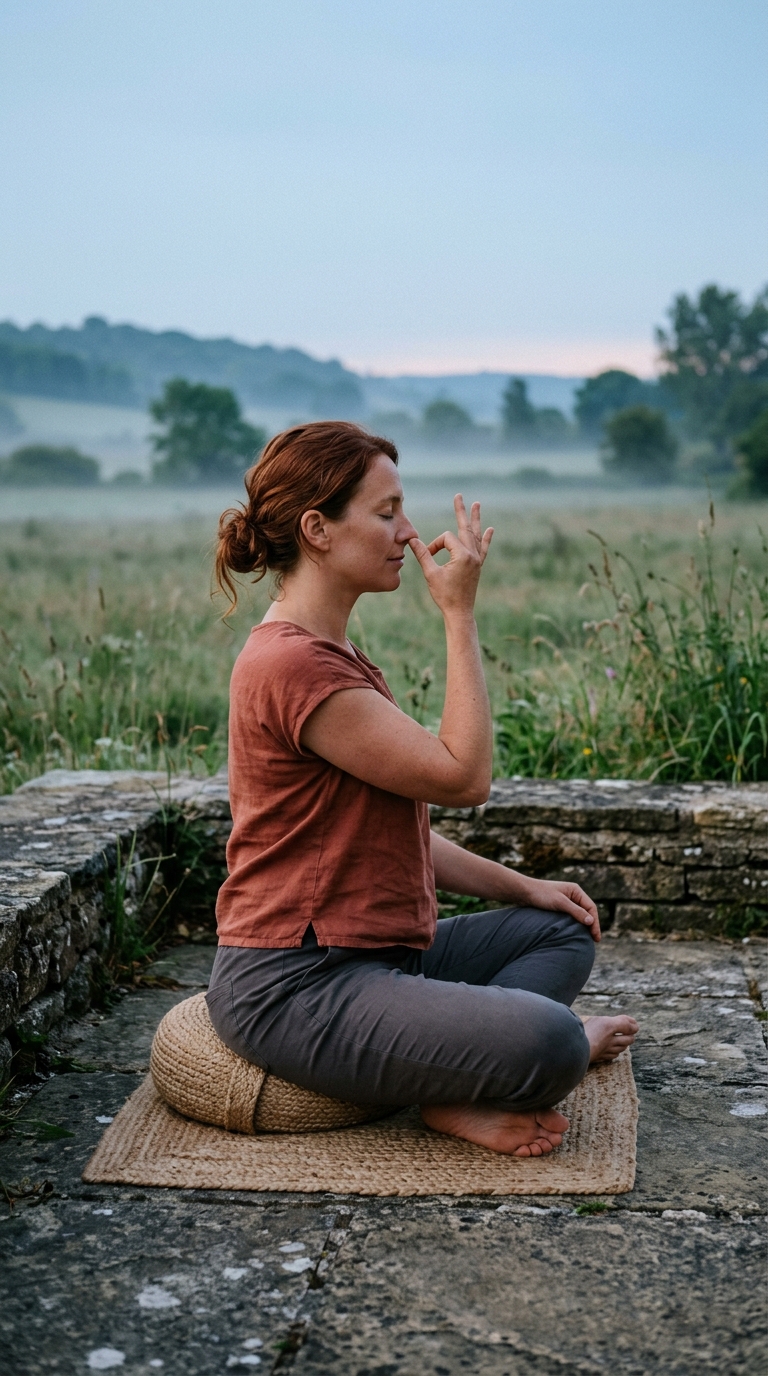
Building a consistent home yoga and breathwork routine is much easier when your sequences, guided audio timers, session history, and practice notes live in one place.
In Ayurveda & Asana Yoga, the Training, Practices, and Notes (`nodes`) tabs connect 908 illustrated asanas and 4,419 yoga sequences (`YogaSeeder` and `ExerciseItem+YogaSearch.swift`) with 60 scripted guided practices (`PracticePlayerView` and `PracticeHistoryView`) and a rich note editor (`NodeEditorView`) that can link specific exercises and foods directly to a dated note.
This guide explains how each of those native features works and how to review any sequence for personal safety before practicing.
How the 4,419 Yoga Sequences and Duration-Weighted Dosha Chips Work
In the Training and Exercises views (`YogaExerciseViews.swift` and `ExerciseItem+YogaSearch.swift`), multi-pose workouts (`isWorkout`) are composed of individual `YogaWorkoutExerciseEntry` items, each with an `ExerciseItem` and a target hold time (`durationSeconds`). To summarize the overall energetic character of a sequence, `YogaWorkoutAyurvedaMath.aggregate` calculates a duration-weighted average (`weight = max(durationSeconds, 1)`) of the Vata, Pitta, and Kapha values across all constituent postures, rounding and clamping the result to `-2...2`.
When supported on iOS 26+ hardware, `AITrainingPlanGenerator` can also populate multi-day workout drafts (`TrainingPlanDraft`) around requested focus areas. Because sequence dosha chips (`modern-synthesis`) and generated drafts are informational, always preview the individual postures in a sequence and skip or modify any pose that conflicts with your joints or medical precautions.
- 4,419 Bundled Sequences: Pre-seeded multi-pose sequences linking warm-ups, standing/active poses, and cooldowns.
- Duration-Weighted Sequence Dosha (`YogaWorkoutAyurvedaMath`): Longer holds (such as a 3-minute restorative pose vs a 20-second transition) carry proportional weight in the sequence's dosha chip.
- Customizable Fields (`ExercisePracticeEditorFields`): Supports posture family (`AsanaFamily`), level (`1–3`), breath (`YogaBreath`), and gaze point (`YogaDrishti`).
Using the 60 Guided Practices: Voice Modes, Ambience, Favorites, and History
The Practices tab (`PracticesView.swift` and `PracticePlayerView.swift`) contains 60 guided sessions with 601 scripted cues across five kinds: 29 meditation, 15 visualization, 11 pranayama, 4 relaxation, and 1 kriya. Before starting a session, you can choose your duration, `voiceMode` (`PracticeVoiceMode`), and optional background ambience (`ambienceResourceName`), then follow the timed on-screen and audio cues.
Completed sessions are saved as `PracticeSession` records in SwiftData and displayed in `PracticeHistoryView`, where you can search your past practice log by title, practice kind, date, start/end time, or actual duration.
- Search & Kind Filters: Search across English title, Sanskrit name, description, and metadata, or filter by Meditation, Visualization, Pranayama, Relaxation, or Kriya.
- Persisted Favorites: Bookmark go-to breathwork or relaxation sessions to your profile.
- Searchable Practice History (`PracticeHistoryView`): Filter completed sessions by title, kind, formatted date/time, or duration.
How to Attach Specific Exercises and Foods to a Note (`NodeEditorView`)
Unlike a plain text notepad, the Notes tab (`NodesListView` and `NodeEditorView`) uses a SwiftData `Node` model that stores not only your `date`, `textContent`, and optional `calendarEventID`, but also direct relationships to catalog or custom exercises (`linkedExercises` / `catalogExerciseIDs`) and foods (`linkedFoods` / `catalogFoodIDs`).
That means you can write a quick post-practice reflection and attach the exact yoga postures or meals you practiced and ate that day—making it easy to remember which prop setup or evening meal helped your practice feel steady.
- Preview your chosen sequence in Training to check individual pose levels (`1–3`), hold durations, and precautions before unrolling your mat.
- Follow a 5- to 10-minute pranayama or relaxation session in Practices after physical asana, choosing your preferred voice mode and ambience.
- Open Notes (`NodeEditorView`) to jot down a brief reflection and link the specific exercises or foods you want to remember.
Sources & Classical References
- NCCIH — Yoga: What You Need To Know — NIH guidance on safe yoga progression, breathwork, and modifying postures for individual needs.
- NCCIH — Meditation and Mindfulness: What You Need To Know — NIH overview of meditation and mindfulness practices alongside conventional care.