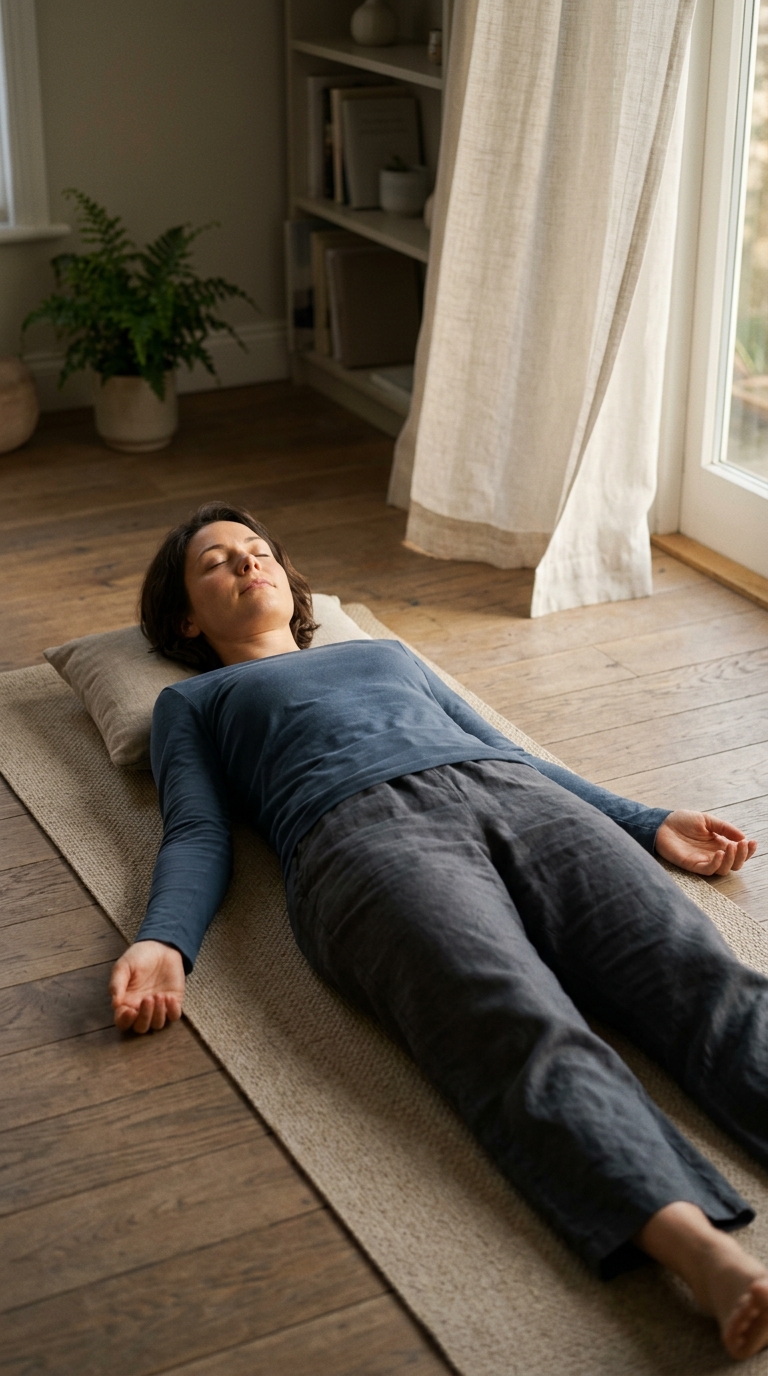
Overview & Traditional Lineage
Rotation of Awareness (Chidakasha Dharana) is a classical meditation rooted in Yoga Nidra lineage; the 61-point rotation, shortened. Attention moves through the body in a fixed order, resting a moment in each place. The order never changes, which is what makes it restful — there is nothing to decide.
Primary Goals: Sleep, Anxiety, Recovery. Themes: Tension, Insomnia.
Full Guided Practice Script & Cue Timeline
| Timestamp | Spoken Cue / Instruction | Pause |
|---|---|---|
| 0:00 | Lie on your back, arms a little away from the sides, palms up. | 12s |
| 0:20 | We will move through the body in a fixed order. You do not have to remember it. Just follow. | 12s |
| 0:44 | Right hand thumb. Second finger. Third. Fourth. Fifth. The palm. The back of the hand. The wrist. | 8s |
| 1:03 | The forearm. The elbow. The upper arm. The shoulder. The armpit. The right side of the waist. The right hip. | 8s |
| 1:24 | The right thigh. The knee. The calf. The ankle. The heel. The sole of the right foot. The right big toe. | 10s |
| 1:47 | Now the same on the left. Left hand thumb. Second finger. Third. Fourth. Fifth. The palm. The wrist. | 8s |
| 2:06 | The forearm. The elbow. The upper arm. The shoulder. The left side of the waist. The left hip. | 8s |
| 2:26 | The left thigh. The knee. The calf. The ankle. The heel. The sole of the left foot. The left big toe. | 10s |
| 2:49 | Now the back of the body. The right shoulder blade. The left. The whole spine, from the base to the neck. | 12s |
| 3:14 | The back of the head. The crown. The forehead. The right eyebrow. The left. The space between them. | 12s |
| 3:37 | The right eyelid. The left. The right cheek. The left. The upper lip. The lower lip. The chin. The throat. | 12s |
| 4:02 | The chest. The stomach. The navel. The whole front of the body at once. | 20s |
| 4:31 | Now the whole body at once. Every part you just visited, all together. | 60s |
| 5:39 | Stay here. Nothing to do. | 90s |
| 7:12 | When you are ready, let one hand move. Then the other. Take your time coming back. | 25s |
Contraindications & Guidance
- Sustained inward attention can be destabilising for people with PTSD or dissociative symptoms. Keep the eyes softly open, or stop, if it becomes uncomfortable.