Classical Ayurvedic Profile & Preparation
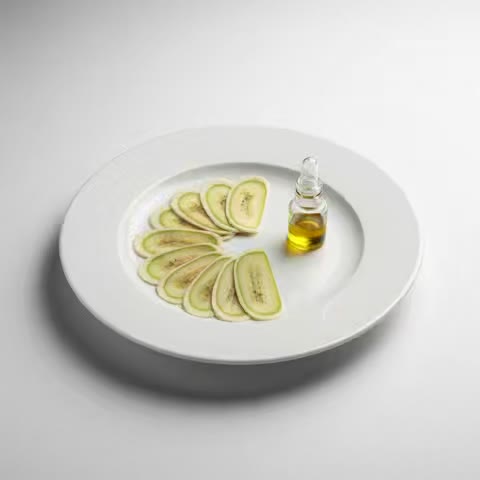
The astringent unripe kadali — binds loose stools and grounds pitta where the ripe fruit would increase kapha.
Traditional Preparation (Samskara)
Always cooked — steamed, curried or as thoran; ghee and coconut offset its dryness.
Classical Provenance: Bhavaprakasha Nighantu (kadali); Kerala tradition.
Synergistic Combinations (Samyoga)
- Kerala kootu/thoran with coconut
- raw banana with buttermilk for loose stools
Contraindications & Viruddha Āhāra (Food Incompatibilities)
- Contraindication: constipation or high vata (dry, binding)
- Contraindication: eating with heavy sweets
Verified USDA Nutrition Facts for Raw banana (plantain)
Complete macronutrient, vitamin, and mineral profile per 100 grams and per 1 cup chopped (100g):
| Nutrient | Per 100g | Per Serving (1 cup chopped) |
|---|---|---|
| Energy (Calories) | 127 kcal | 127 kcal |
| Protein | 22.1 g | 22.1 g |
| Total Carbohydrates | 0 g | 0 g |
| Dietary Fiber | 0 g | 0 g |
| Total Sugars | 0 g | 0 g |
| Total Fat | 4.2 g | 4.2 g |
| Calcium | 8.6 mg | 8.6 mg |
| Iron | 0.38 mg | 0.38 mg |
| Magnesium | 26.2 mg | 26.2 mg |
| Phosphorus | 207.0 mg | 207.0 mg |
| Potassium | 390 mg | 390 mg |
| Sodium | 36 mg | 36 mg |
| Zinc | 0.35 mg | 0.35 mg |
| Copper | 0.02 mg | 0.02 mg |
| Manganese | 0 mg | 0 mg |
| Selenium | 16.9 µg | 16.9 µg |
| Vitamin C | 0 mg | 0 mg |
| Vitamin A (RAE) | 25.6 µg | 25.6 µg |
| Vitamin E | 0.58 mg | 0.58 mg |
| Vitamin K | 1.0 µg | 1.0 µg |
| Thiamin (Vitamin B1) | 0.04 mg | 0.04 mg |
| Riboflavin (Vitamin B2) | 0.01 mg | 0.01 mg |
| Niacin (Vitamin B3) | 1.86 mg | 1.86 mg |
| Vitamin B6 | 184.00 mg | 184.00 mg |