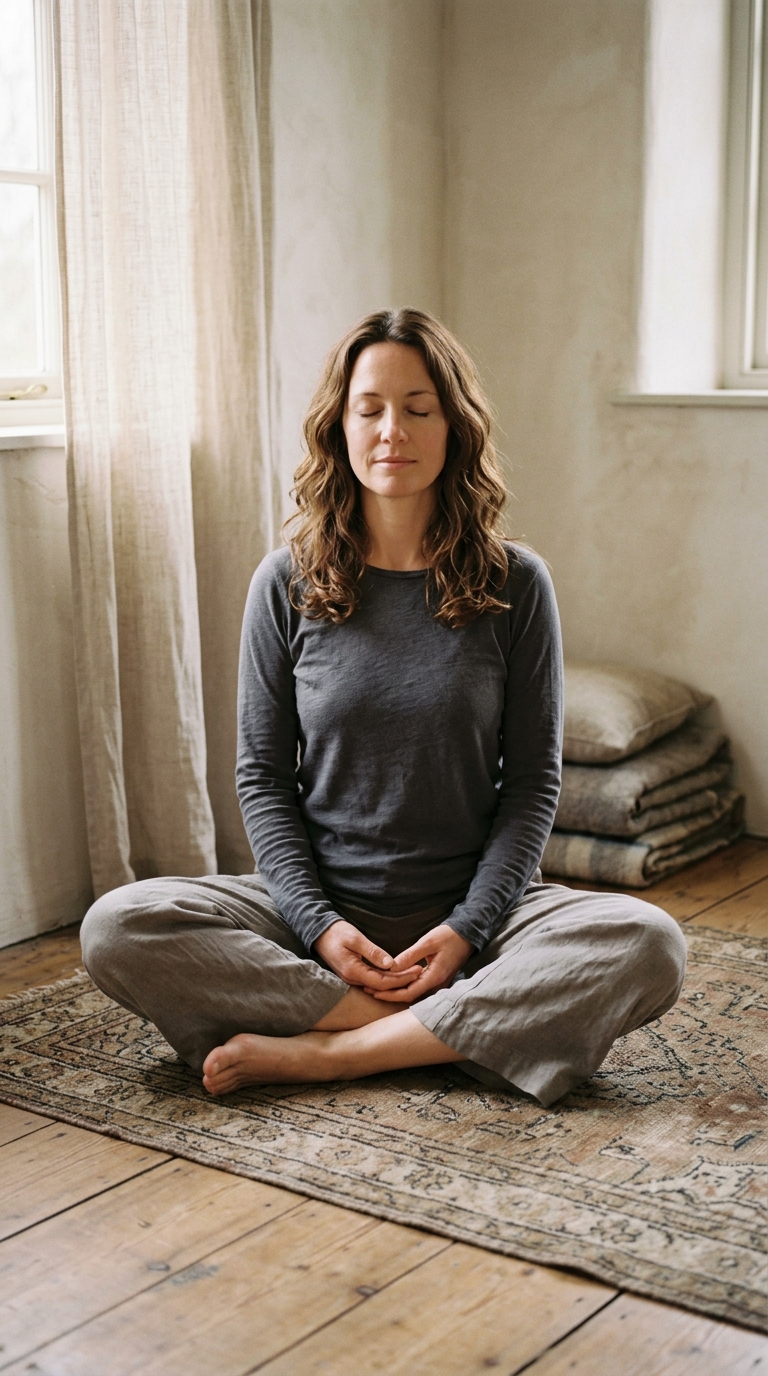
Savasana and yoga nidra both happen lying on your back with the eyes usually closed, and a yoga nidra session can look from the outside like a very long savasana. They are different practices. Savasana is a pose, usually a few quiet minutes at the end of a class. Yoga nidra is a guided sequence of attention exercises with a defined structure that usually takes considerably longer.
This guide explains each, compares them, and summarises what research on yoga nidra has and has not shown.
Savasana: the corpse pose
Savasana appears in the fifteenth-century Hatha Yoga Pradipika. In Pancham Sinh's 1914 translation: 'Lying down on the ground, like a corpse, is called Śava-âsana. It removes fatigue and gives rest to the mind.' The Sanskrit specifies lying on the back.
In modern classes, savasana is typically a few minutes of stillness at the end of a session. Instructions are minimal: lie down, let the body be still, let the breath be natural. Some teachers add a brief body scan or a few words; many stay silent. There is no fixed sequence, and the main instruction is to stop doing things.
Yoga nidra: a guided, staged practice
The name is often translated as 'yogic sleep', though the practice aims for a relaxed state in which you remain aware, rather than actual sleep. The term has older roots, but the practice as most people encounter it today was systematised by Swami Satyananda Saraswati of the Bihar School of Yoga in the twentieth century; reviews date this to the 1960s and to his 1976 book. It should be understood as a modern systematisation rather than a technique described in medieval hatha texts.
Satyananda's sequence, as summarised in recent reviews, follows broadly these stages:
- Preparation: settling into a lying position and becoming still.
- Sankalpa: silently stating a short personal resolution.
- Rotation of consciousness: moving attention quickly through named parts of the body in a set order.
- Breath awareness: noticing or counting the natural breath.
- Opposite sensations: recalling pairs such as heaviness and lightness, or warmth and cold.
- Visualisation: a series of suggested images.
- Return of the sankalpa, then a gradual return to ordinary awareness.
Side-by-side comparison
The two practices share a position but little else.
- Structure: savasana has none beyond lying still; yoga nidra follows a defined sequence of stages.
- Guidance: savasana is often silent; yoga nidra is almost always guided, live or recorded.
- Length: savasana is usually a few minutes; a full yoga nidra session is usually much longer, because it works through several stages.
- Place in practice: savasana usually closes a pose-based class; yoga nidra is a session in its own right.
- Attention: in savasana you rest without a specific task; in yoga nidra you follow a series of instructions.
- Imagery: savasana involves none unless a teacher adds it; yoga nidra typically includes visualisation and opposite sensations.
Choosing between them
If you want to finish a yoga session by letting the body settle, savasana is enough, and it needs no recording. If you want a longer, structured relaxation practice in its own right, yoga nidra provides one.
Some parts of yoga nidra do not suit everyone. Visualisation can be difficult for people who do not form mental images easily, and recalling opposite sensations or certain images can bring up unwanted memories. You can skip any stage, open your eyes, or choose a recording that leaves out visualisation. Falling asleep during yoga nidra is common; if your aim is to stay aware, a slightly firmer surface or a reclined rather than flat position may help.
What research on yoga nidra shows
Yoga nidra has been studied mainly for stress, anxiety, sleep and mood. A 2025 systematic review and meta-analysis by Ghai and colleagues included 73 studies with 5,201 participants and found moderate-to-large effects on stress, anxiety and depression. The authors cautioned that because of low methodological quality and variation in how the practice was delivered, these effects likely reflect inflated estimates.
An earlier review by Pandi-Perumal and colleagues was more enthusiastic in tone. Taken together, the evidence suggests yoga nidra is a reasonable relaxation practice with promising but low-certainty research behind it. It is not a treatment for anxiety, depression or sleep disorders, and should not replace care for them.
Points of care
Lying flat for a long time is uncomfortable for some people, including in later pregnancy and with some back problems. Lying on your side, or reclining with the head and knees supported, is fine for either practice. If a practice brings up distressing memories or a sense of unreality that does not pass, stop, open your eyes and reorient to the room. If such effects keep returning, discuss them with a health care provider.
Sources & Classical References
- Hatha Yoga Pradipika, translated by Pancham Sinh (1914), chapter 1 — Public-domain translation of the verse defining savasana (numbered 1.34 in this edition, 1.32 in many others).
- Pandi-Perumal et al. (2022), The Origin and Clinical Relevance of Yoga Nidra, Sleep and Vigilance — Background on Swami Satyananda's systematisation and the stages of the practice.
- Ghai, Odyniec and Ghai (2025), Effects of Yoga Nidra on Stress, Anxiety, and Depression: A Systematic Review and Meta-Analysis, Annals of the New York Academy of Sciences — Pooled findings with the authors' caution about study quality and likely inflated estimates.