{'heading': 'How to practice Trataka safely without eye strain', 'summary': 'Trataka is a focused-attention practice (`dharana` and `shatkarma`) that alternates soft outward gazing at a single small object placed at seated eye level (1 to 1.5 meters away) with eyes-closed internal visualization. If you spend hours at digital screens or have dry eyes, use a non-illuminated matte object (such as a dark paper dot, stone, or flower bud) rather than a candle flame, and blink gently whenever your eyes feel dry.', 'bullets': ["Setup geometry: Place the focal object 1 to 1.5 meters (arm's length plus a foot) away at exact seated eye level so the neck neither droops nor tilts back.", 'Blink-suppression caution: Forcing your eyes wide open until tears stream destabilizes the lipid-aqueous tear film and irritates dry corneas; use a soft, relaxed eyelid posture and blink when needed.', 'Matte object vs. candle flame: A non-luminous dot eliminates retinal afterimage glare and indoor fire hazards.', 'Cycle structure: Gaze softly for 20–40 seconds, then close the eyes and rest darkness over the eyelids for 40–60 seconds.']}
Trataka is a focused-attention practice (`dharana` and `shatkarma`) that alternates soft outward gazing at a single small object placed at seated eye level (1 to 1.5 meters away) with eyes-closed internal visualization. If you spend hours at digital screens or have dry eyes, use a non-illuminated matte object (such as a dark paper dot, stone, or flower bud) rather than a candle flame, and blink gently whenever your eyes feel dry.
Setup geometry: Place the focal object 1 to 1.5 meters (arm's length plus a foot) away at exact seated eye level so the neck neither droops nor tilts back.
Blink-suppression caution: Forcing your eyes wide open until tears stream destabilizes the lipid-aqueous tear film and irritates dry corneas; use a soft, relaxed eyelid posture and blink when needed.
Matte object vs. candle flame: A non-luminous dot eliminates retinal afterimage glare and indoor fire hazards.
Cycle structure: Gaze softly for 20–40 seconds, then close the eyes and rest darkness over the eyelids for 40–60 seconds.
What Trataka Trains: External Anchor to Internal Stillness
For many people, closing the eyes to meditate immediately unleashes a stream of visual daydreaming and mental chatter. `Trataka`—described in both Hatha yoga texts (`Hatha Yoga Pradipika` 2.31–32) and concentration (`dharana`) manuals—uses the visual system's natural link to attention: when the eyes stop darting around the room in rapid saccades, cognitive restlessness tends to quieten alongside them.
A structured Trataka session alternates two phases: `bahiranga` (external gazing at a single small point without scanning the surrounding room) and `antaranga` (closing the eyes and holding attention on the memory or subtle impression of that point in the space behind the forehead, followed by resting in quiet darkness).
- Phase 1 — External gaze (20 to 45 seconds): Rest your eyes softly on the chosen point while keeping the forehead, temples, jaw, and shoulders completely relaxed.
- Phase 2 — Eyes-closed rest (45 to 60 seconds): Close the eyelids gently without squeezing them shut and observe the quiet space behind the brow.
- Phase 3 — Palming release: Rub the clean palms together until warm and cup them lightly over the closed eye sockets (without pressing on the eyeballs) for three slow breaths.
Protecting the Tear Film: Why Screen Users Should Modify Classical Instructions
Classical medieval descriptions of Trataka were written long before backlit LED monitors, air conditioning, and contact lenses. During a typical workday at a computer or smartphone, human blink rate already drops by 50% to 60%, leaving many modern practitioners with evaporative dry-eye symptoms before they ever sit on a meditation cushion.
Attempting literal unblinking staring until tears overflow causes the corneal tear film to break up, triggering reflex lacrimation (watery emergency tears that lack normal lipid lubrication) and leaving the eyes gritty or irritated afterward. Modern ocular-safe Trataka keeps the gaze steady in direction while allowing a calm, natural blink whenever the surface of the eye feels dry, and removes contact lenses or high-powered near-vision reading glasses before starting.
- Choose a non-luminous focal point if your eyes are tired: A 1 cm matte black or deep blue dot on cream card stock, a small shell, or a leaf at 1.2 meters causes zero glare.
- Remove contact lenses first: Contact lenses dry out rapidly when blink frequency decreases.
- Who should skip candle/flame gazing: Avoid bright point-light gazing if you have dry-eye syndrome, photophobia, migraine with visual aura, glaucoma, cataract sensitivity, or retinal conditions.
Exact Room Setup and Fire-Safety Checklist
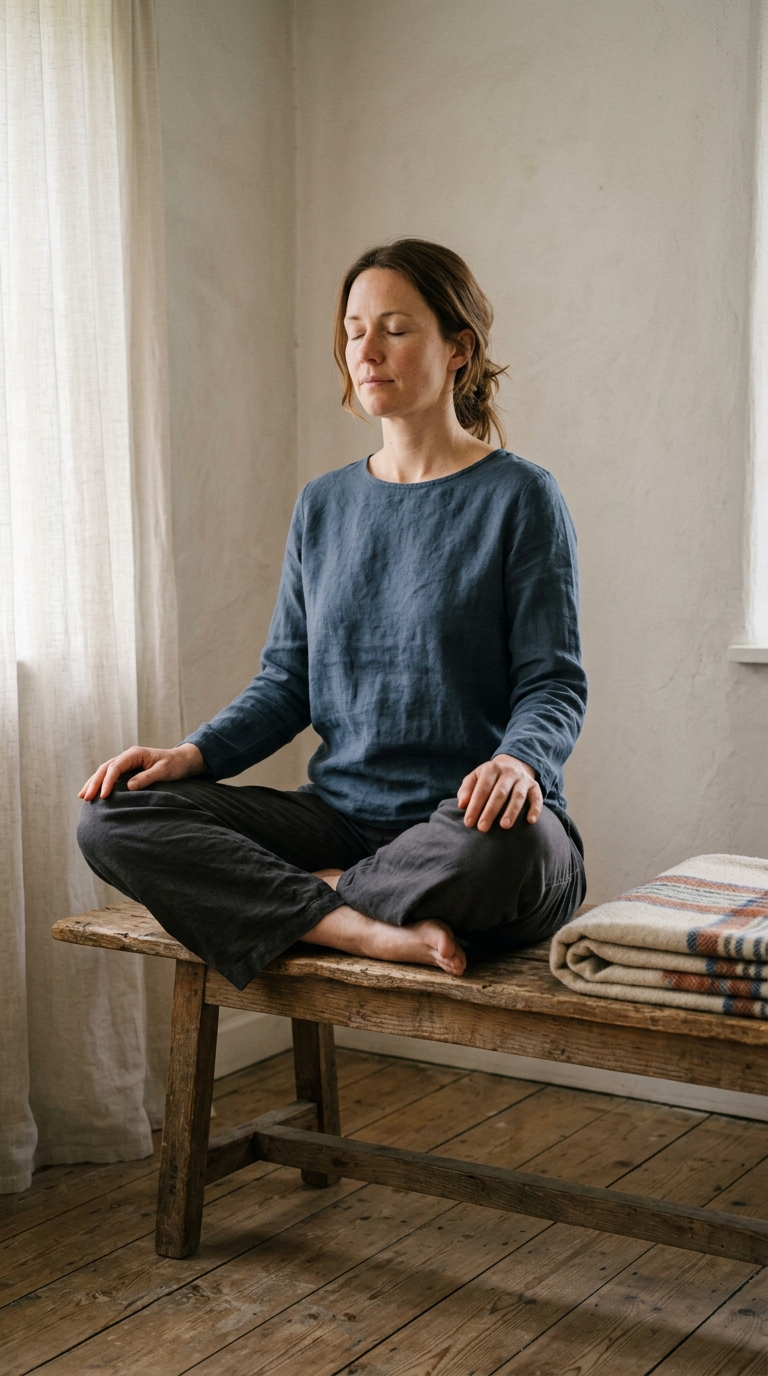
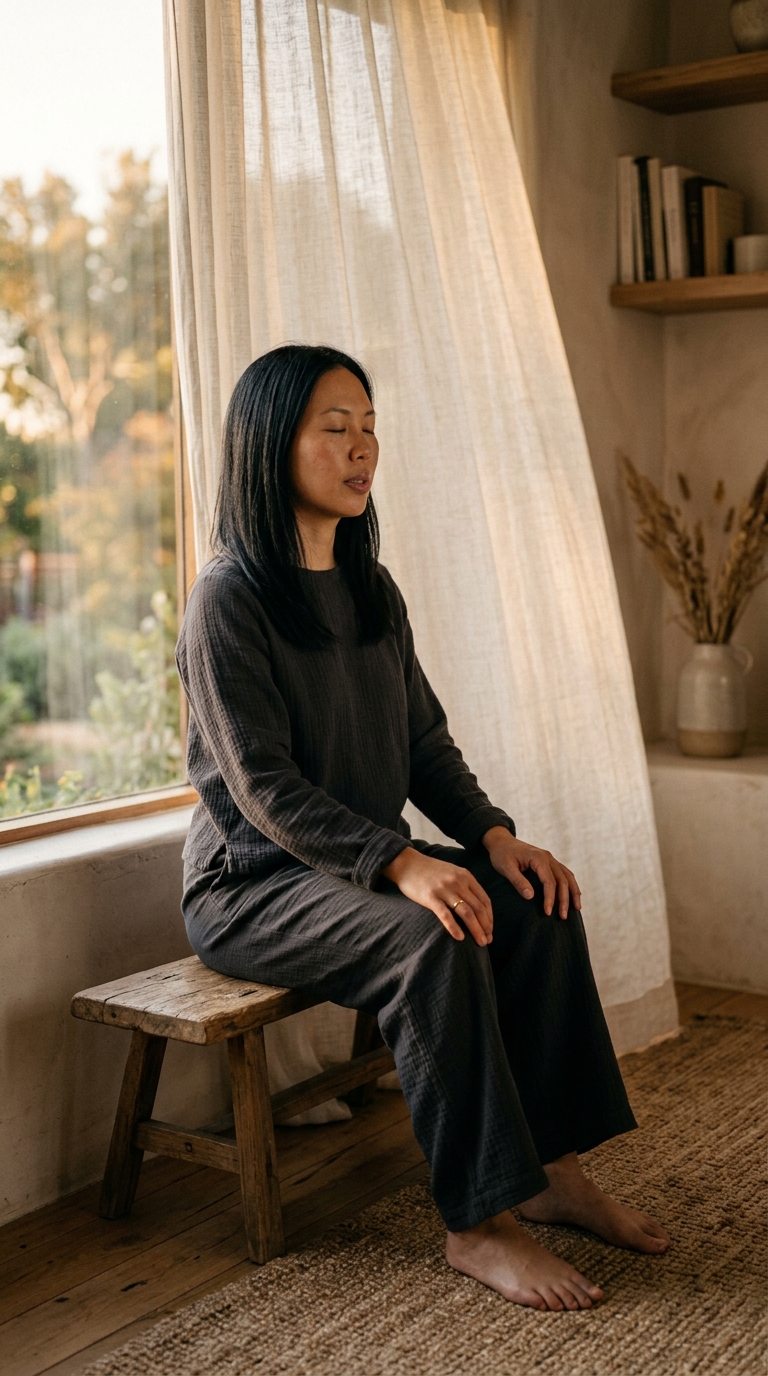
If you set your focal object on the floor in front of your mat, your head pitches forward by 30 to 45 degrees, loading the posterior neck muscles throughout the practice. Always elevate the object on a stack of books, a shelf, or a table so it sits level with the bridge of your nose when you are seated on your cushion or chair.
If you do choose to use a traditional ghee lamp or unscented beeswax candle in a dimly lit room (neither pitch-black, which maximizes pupil dilation and glare contrast, nor brightly lit), follow strict fire-safety rules: place the candle in a heavy, non-tipping holder on a non-flammable tray away from curtains, pets, and fans, and extinguish it completely before transitioning into eyes-closed supine rest.
- Distance & height: 1.0 to 1.5 meters away, aligned horizontally with your eyes when seated tall.
- Draft-free room: A flickering flame forces the eye muscles to track movement constantly; turn off fans or use a stationary paper dot.
- In the `Ayurveda & Asana Yoga` app: Check the `Eyes` metadata pill (`Eyes open` vs. `Eyes closed`) in `Practice Details` before starting any guided concentration or kriya session.
Frequently Asked Questions
Is a black dot on paper as effective for concentration as a candle flame?
Yes. For training steady visual attention (`dharana`) and reducing eye saccades, a high-stability matte dot on neutral paper works just as well as a flame without causing retinal glare or fire risk.
How long should a complete Trataka session last for a beginner?
Three to five minutes total (consisting of 3 or 4 short cycles of 30 seconds soft gazing and 45 seconds eyes-closed rest, finishing with warm palming) is ideal when starting out.
Should I wear my glasses during Trataka?
If you wear distance glasses and need them to see an object 1.2 meters away without squinting, you can keep them on (unless glare reflects off the lenses); remove contact lenses so your corneas stay hydrated.