Classical Ayurvedic Profile & Preparation
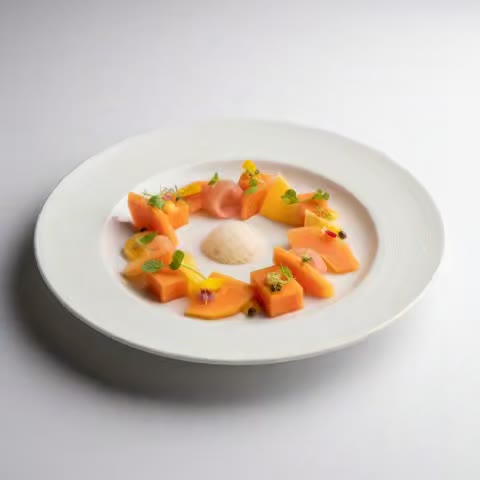
The morning digestive fruit — residual papain gently clears the bowels and supports agni where most sweet fruits dampen it.
Traditional Preparation (Samskara)
Fully ripe, eaten alone in the morning; one of the few fruits that suits weak digestion.
Classical Provenance: regional tradition; contemporary Ayurvedic practice.
Synergistic Combinations (Samyoga)
- with lime juice and black salt
- alone before breakfast for sluggish bowels
Contraindications & Viruddha Āhāra (Food Incompatibilities)
- Contraindication: pregnancy (traditional caution even for ripe fruit)
- Contraindication: high pitta in excess
- Contraindication: latex allergy
Verified USDA Nutrition Facts for Ripe papaya
Complete macronutrient, vitamin, and mineral profile per 100 grams and per 1 cup pieces (150g):
| Nutrient | Per 100g | Per Serving (1 cup pieces) |
|---|---|---|
| Energy (Calories) | 24 kcal | 36 kcal |
| Protein | 0.4 g | 0.6 g |
| Total Carbohydrates | 4.6 g | 6.9 g |
| Dietary Fiber | 2.8 g | 4.2 g |
| Total Sugars | 4.1 g | 6.1 g |
| Total Fat | 0.2 g | 0.2 g |
| Calcium | 15.0 mg | 22.5 mg |
| Iron | 0.23 mg | 0.35 mg |
| Magnesium | 11.0 mg | 16.5 mg |
| Phosphorus | 17.7 mg | 26.6 mg |
| Potassium | 173 mg | 260 mg |
| Sodium | 7 mg | 10 mg |
| Zinc | 0.08 mg | 0.12 mg |
| Copper | 0.04 mg | 0.06 mg |
| Manganese | 0.03 mg | 0.04 mg |
| Selenium | 12.8 µg | 19.2 µg |
| Vitamin C | 43.1 mg | 64.6 mg |
| Vitamin A (RAE) | 1342.0 µg | 2013.0 µg |
| Vitamin E | 0.04 mg | 0.06 mg |
| Vitamin K | 2.6 µg | 3.9 µg |
| Thiamin (Vitamin B1) | 0.03 mg | 0.04 mg |
| Riboflavin (Vitamin B2) | 0.11 mg | 0.17 mg |
| Niacin (Vitamin B3) | 0.33 mg | 0.49 mg |
| Vitamin B6 | 0.04 mg | 0.06 mg |